Jaagruk Bharat is a private organization offering support for documentation and government scheme access. We are not affiliated with any government body. Official services are available on respective government portals. Our goal is to make processes easier and more accessible for citizens.
Jaagruk Bharat is a private organization offering support for documentation and government scheme access. We are not affiliated with any government body. Official services are available on respective government portals. Our goal is to make processes easier and more accessible for citizens.
CKYC Explained: One-Time KYC That Saves You Huge Time & Hassle

Updated: 11-04-2026 at 12:30 PM


1k

Serving Over
500K+ Users


In India, opening a bank account, purchasing insurance, investing in mutual funds, applying for a loan, or purchasing regulated financial products almost always requires identity verification. Earlier, customers had to submit the same identity and address documents separately to every financial institution. This repeated submission increased paperwork, caused delays, and often led to inconsistent records across institutions.
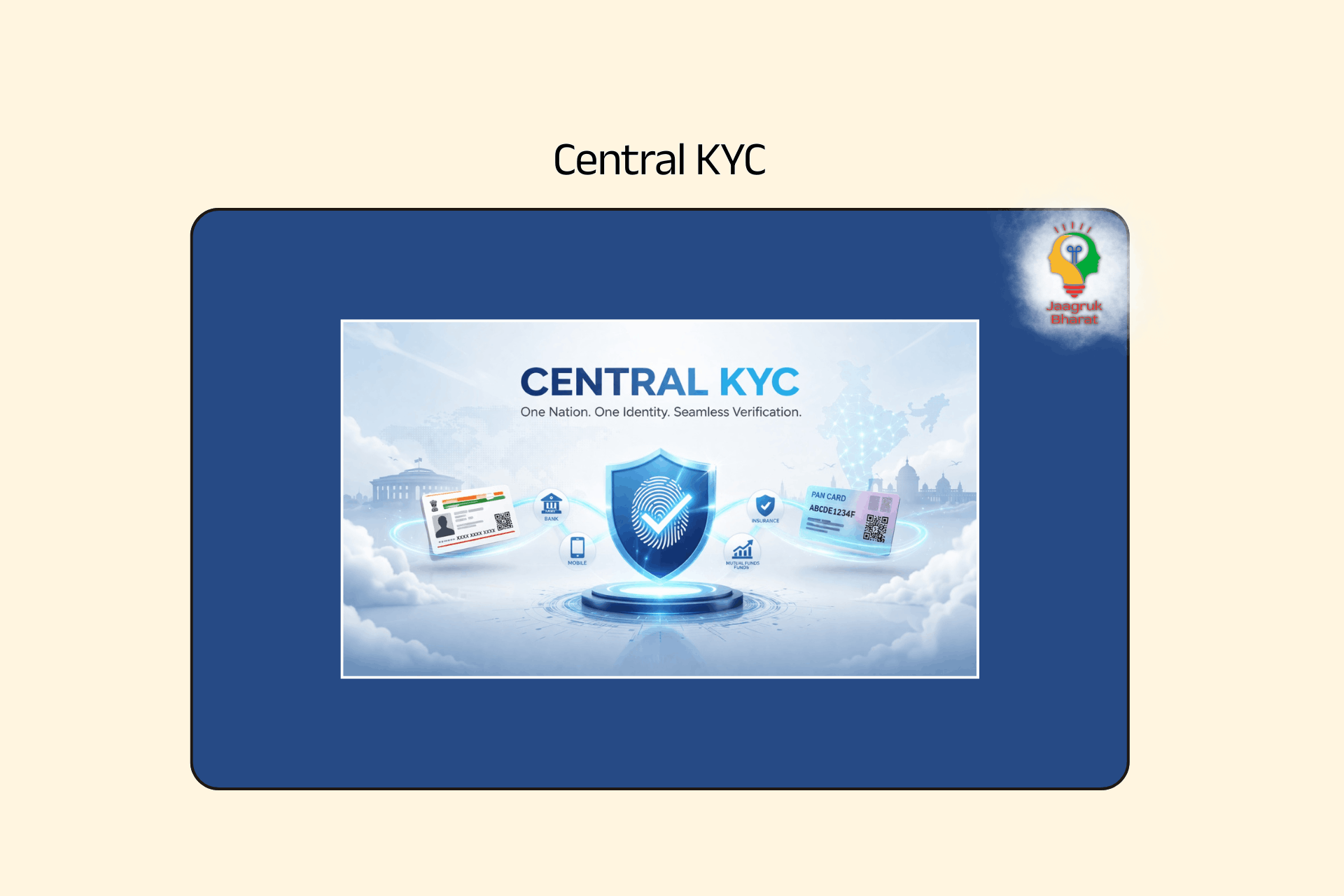
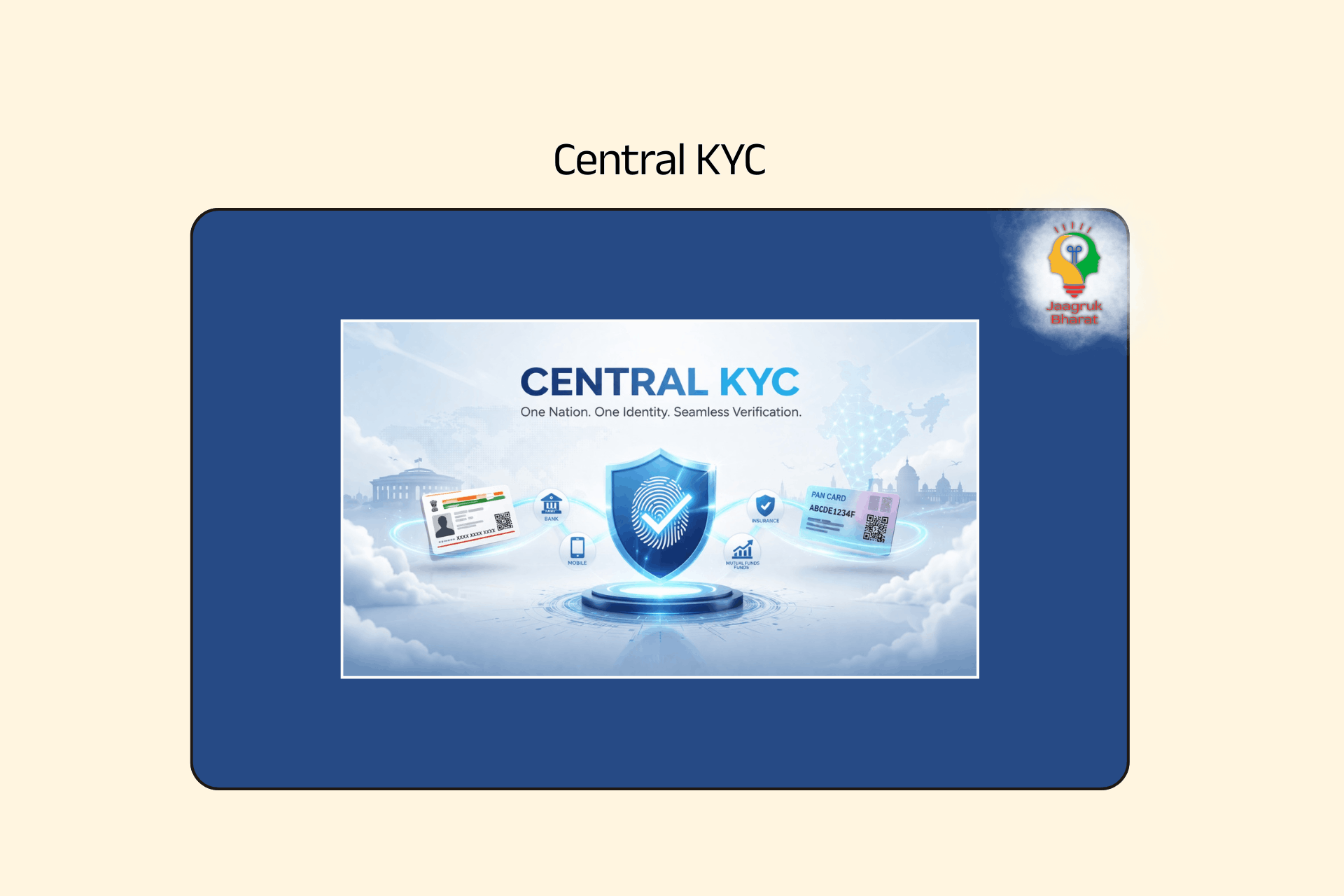
To solve this problem, the Government of India introduced the Central KYC framework, commonly known as CKYC India. The system created a central repository where verified customer records are stored once and then reused across multiple regulated financial institutions.
Today, CKYC has become one of the most searched financial queries because this framework has transformed customer verification in India. Instead of repeating KYC at every institution, individuals receive one permanent CKYC Number, which can be used across banks, insurers, mutual funds, pension platforms, stockbrokers, and NBFCs.
Also Read: Complete Your CKYC Now With Jaagruk Bharat: 100% Online, Click Here.
The system is maintained by the Central Registry of Securitisation Asset Reconstruction and Security Interest of India in compliance with anti-money-laundering rules. It supports institutions regulated by:
-
Reserve Bank of India.
-
Securities and Exchange Board of India.
-
Insurance Regulatory and Development Authority of India.
-
Pension Fund Regulatory and Development Authority.
As digital financial onboarding expands rapidly, CKYC registration online in India has become increasingly important because institutions now rely heavily on central verification for faster approvals.
Central KYC Overview
The table below highlights the key insights of the CKYC in India:-
| Particular | Details |
|---|---|
| Full Form | Central Know Your Customer |
| Common Name | CKYC |
| Governing Registry | Central Registry of Securitisation, Asset Reconstruction, and Security Interest of India. |
| Regulated Under | Anti-money laundering compliance framework |
| Unique Identifier | 14-digit CKYC Number / KIN |
| Main Purpose | One-time KYC for multiple financial institutions |
| Applicable Sectors | Banks, NBFCs, insurance, mutual funds, pension, and the stock market. |
| Registration Mode | Through authorised financial institutions. |
| Main Documents Required | PAN card, Aadhaar card, address proof, photograph, signature |
| Validity | Usually, a lifetime unless major details change. |
| Update Facility | Through an authorised bank, insurer, broker, or fund house. |
| Digital Availability | Supported through Aadhaar OTP, video verification, and digital uploads |
| Main Benefit | Avoids repeated document submission across institutions |
What Is CKYC?
CKYC stands for Central Know Your Customer. It is a centralised digital repository where an individual's verified KYC details are stored after submission through a registered financial institution. Unlike traditional KYC, which remains limited to one institution, Central KYC allows customer data to be reused across multiple regulated institutions. Once verification is completed, the applicant receives a permanent CKYC Number that remains linked to future financial onboarding. The system was introduced to:
-
Remove duplicate KYC submissions across multiple financial institutions.
-
It was designed to standardise verification procedures across regulated institutions.
-
It also helps reduce fraud risks linked to inconsistent identity records.
-
Another key objective was to improve regulatory compliance under anti-money laundering rules.
-
It also speeds up onboarding for financial products by reducing repeated document checks.
This makes the CKYC vs KYC difference highly significant because traditional KYC often requires repeated submissions, whereas CKYC creates one central identity record.
Also Read: Understanding Digital India Programme: National e-Vidhan Application (NeVA)
Who Maintains the CKYC Registry?
Central Registry of Securitisation, Asset Reconstruction and Security Interest of India maintains the CKYC database. CERSAI is the official central repository of the KYC records in India and handles the safe storage, retrieval, and updating of the information about the customers. Its role includes:
-
It stores customer KYC records securely within a central repository.
-
It provides CKYC identification numbers after successful verification.
-
It enables authorised institutions to retrieve records when customer consent is available.
-
It allows updates whenever customer details change in official records.
This centralisation assists in avoiding repetition of the verification process within sectors.
What Is A CKYC Number?
Once the CKYC has been successfully registered, a unique identification number of 14 characters, also known as KIN (KYC Identification Number), is assigned to the applicant. This figure serves as your ultimate KYC point of reference. The key aspects of the CKYC number:
-
The CKYC number contains 14 digits and acts as a permanent financial identity reference.
-
It usually remains permanent unless major record changes are required.
-
It works across multiple regulated financial institutions in India.
-
It helps minimise repeated document submission during onboarding.
Customers can employ this number once they open accounts, invest, take insurance or apply to regulated financial products once they have been issued. Once generated, this number can be used while:
-
Opening bank accounts.
-
Buying insurance.
-
Investing in mutual funds.
-
Applying for loans.
-
Onboarding with brokers.
Those who have questions regarding the CKYC number kaise nikale because they often complete KYC through institutions without knowing their number was already generated.
What Is The Reason Behind Introducing CKYC In India?
All financial institutions used to be unique in their KYC process before CKYC.
For example:
-
One bank often requested PAN and Aadhaar separately for account opening.
-
Mutual fund houses usually require fresh verification even after earlier KYC completion.
-
Insurance companies often ask customers to submit address proof repeatedly.
The primary objective of the introduction of CKYC was to address:
-
First, it aim to reduce repeated paperwork across institutions.
-
It aimed to improve consistency in customer identity records.
-
It also helped lower fraud possibilities in the financial system.
-
Another goal was to make financial onboarding faster and smoother.
It also aids in the monitoring of anti-money laundering based on Indian financial regulations.
Where Is CKYC Used?
An individual with CKYC can onboard more quickly because authentic information is already provided to institutions to which it is permitted. In India, CKYC is recognised in large financial industries. It is commonly used in:
-
Banks
-
NBFCs
-
Mutual funds
-
Insurance companies
-
Stockbrokers
-
Pension platforms
-
Loan providers
How Does CKYC Work?
It starts with a customer providing KYC documents to a registered institution. The institution then:
-
The institution first verifies all submitted documents carefully.
-
It then posts customer information to the CKYC registry.
-
The verified data is sent to CERSAI for central processing.
-
After successful verification, confirmation is received.
-
The customer then receives a 14-digit CKYC number.
Also Read: RBI Mandates Two-Factor Authentication For Digital Payments From April 1, 2026
CKYC Form Download PDF and Submission
Many applicants search CKYC form download PDF before starting registration. The CKYC Form contains:
-
Full name
-
Father's or mother's name
-
Date of birth
-
PAN details
-
Aadhaar details
-
Address
-
Contact details
-
Signature
Those looking to download the CKYC form online should ensure that the latest accepted format is used because institutions may reject outdated versions. The form must be filled out carefully because even minor spelling mismatches may delay approval.
Documents That Are Necessary To Register CKYC
The requirements of documents are not complicated, but should be precise. Typically, the documents needed are:
-
Passport-size photograph.
Proofs of accepted addresses can be:
-
Aadhaar.
Utility bill under some circumstances. Other institutions will demand more information, such as the name of the mother or maiden name, since CKYC facilitates wider identity fields compared with conventional KYC.
Registration Of CKYC
Registration in CKYC is usually carried out by a financial institution since the customers are not directly able to do self-registration at the registry.
Step 1: Select a bank, mutual funds provider, insurer or NBFC.
Step 2: Present identity and address documents.
Step 3: The institution identifies authenticity.
Step 4: Authenticated records are uploaded on a central basis.
Step 5: An appropriate number of 14 numbers is generated after successful processing.
Verification is usually provided when the institutions send the CKYC number via SMS or email.
Can CKYC Be Done Online?
Yes, in most situations, the institutions are now favouring partial or full digital submission. This may include:
-
OTP verification based on Aadhaar.
-
Video KYC
-
Digital document upload
-
PAN validation
The recent banking reforms have widened the digital onboarding, and CKYC has become more convenient in the online financial application. Nevertheless, it cannot be completely accepted until there are checks against compliance as specified by institutions.
Jaagruk Bharat lets you complete your CKYC from the comfort of your home. Start your Application Now!
Types Of CKYC Accounts
There are several classes of CKYC that one should know about. Let’s look at them one by one..
| Type | Description |
|---|---|
| Normal CKYC | Normal CKYC is applied when applicants submit officially valid documents such as a PAN card, Aadhaar card, passport, or voter ID for full verification. |
| Simplified CKYC | Simplified CKYC is used when fewer documents are available, but the applicant still provides acceptable, limited proof under the allowed guidelines. |
| Small Account CKYC | Small Account CKYC is applied when full documentation is not available, and such accounts usually operate with transaction and balance limitations until full verification is completed. |
| OTP-Based eKYC | OTP-Based eKYC is completed through Aadhaar-linked mobile verification, where authentication is done by entering a one-time password received on the registered mobile number. |
All categories have an influence on the level of usability in the process of financial onboarding.
Benefits Of CKYC
CKYC is beneficial in real life to both consumers and financial institutions. Main benefits include:
-
One-time KYC completion
-
Quickened financial onboarding.
-
Less duplication of documents.
-
Easier updates
-
Stronger fraud monitoring
Customer operational advantages:
-
Fewer branch visits.
-
Quicker approval
-
Smoother account opening
In the case of institutions, CKYC also minimises cost in compliance and enhances standardisation.
Also Read:
CKYC vs KYC vs eKYC
These three systems tend to be mixed up; however, they are not structured alike.
| Type | Description |
|---|---|
| Normal KYC | Normal KYC is specific to individual financial institutions, which means customers usually need to complete the verification process separately each time they open an account or use a new financial service. |
| eKYC | eKYC is a digital verification method in which identity authentication is usually completed electronically through Aadhaar-based verification. |
| CKYC | CKYC is a centralised KYC system where one verified record is stored in a single registry and can be used across multiple financial institutions. |
CKYC has the widest reusability due to the fact that the same figure can be used with a variety of regulators.
Also Read: Digital Arrest Call Scams.
Is CKYC Mandatory?
CKYC is effectively mandatory whenever customers interact with regulated financial institutions requiring formal identity verification. This applies to:
-
Investment onboarding
-
Insurance purchase
-
Mutual fund registration
-
Major account opening
Because financial regulators require standard identity compliance, institutions rely heavily on CKYC records.
How Long Is CKYC Valid?
A CKYC number usually remains valid for life. However, records must be updated when major details change.
Common updates include:
-
Mobile number
-
Address
-
Name
-
Email
-
Identity document changes
A valid CKYC number does not expire, but outdated records may create transaction friction.
Also Read: What Is the Digital Personal Data Protection Act, 2023?
Can CKYC Be Updated?
Yes, but updates usually happen through authorised institutions. Customers cannot directly edit registry records independently.
Updates can be requested through:
-
Banks
-
Mutual fund houses
-
Insurers
-
Brokers
After verification, the revised data is uploaded centrally.
Why Do People Receive CKYC SMS Alerts?
Many users receive SMS messages showing that their CKYC record was fetched or updated. This usually happens when:
-
A bank accesses records.
-
A new product application is processed.
-
Periodic KYC update occurs.
Experts indicate that many customers confuse these alerts with scams, but messages from CKYCR-linked sender IDs often indicate authorised fetch activity linked to financial processing. Still, customers should verify directly if the activity seems unexpected. Always check the senders details before processing through any financial or personal activity. Stay safe, and scam free!
Latest Developments In CKYC
India is preparing an upgraded CKYC infrastructure. A major upcoming development is CKYC Registry 2.0, which is expected to integrate with DigiLocker for smoother document retrieval and easier KYC portability. This upgrade aims to:
-
Improve retrieval speed.
-
Simplify updates
-
Reduce manual intervention.
-
Strengthen digital verification systems.
This is expected to significantly improve customer experience in the coming years.
Also Read: A Warning By NPCI Concerning Growing Online Scams Especially Digital Arrest
Common Problems Faced During CKYC
Understanding these common issues helps applicants identify the reason behind delays and take corrective action quickly.
Some commonly reported CKYC-related problems include:
-
CKYC number not found often appears when the customer’s KYC has not yet been uploaded by the financial institution, or when the record is still under processing in the central database.
-
Status pending usually means that submitted documents are under verification and final approval has not yet been completed by the authorised institution or reporting agency.
-
Mismatch in PAN and Aadhaar details can occur when the name, date of birth, or spelling entered in one document does not exactly match the other document.
-
Duplicate mobile records may arise when the same mobile number is already linked with multiple financial accounts or previously submitted KYC profiles.
-
Incorrect document upload can also delay CKYC approval if unclear scans, expired proofs, or incomplete documents were submitted during registration.
-
Old address records may create verification issues when current financial records do not match the latest address proof provided by the applicant.
Sometimes, bank app integration may fail to fetch records instantly, especially in digital onboarding systems. Usually, branch support or institutional correction resolves these issues.
Who Needs CKYC In India?
CKYC applies to virtually all clients of regulated financial services in India. It applies to almost everywhere in the financial sector where identity verification is an important requirement. People requiring CKYC frequently are:
-
New bank accounts for the salaried employees.
-
Professionals who are self-employed and apply for loans.
-
Investors are buying mutual funds.
-
The elderly are purchasing insurance coverage.
-
Pension subscribers.
-
Stock market investors.
An individual can also require CKYC when a fixed deposit, recurring deposit, wealth product, or some other high-value financial product is being applied for. Because central verification is now the rule in most of the regulated institutions, performing the CKYC early is useful to prevent future delays.
The CKYC is particularly helpful to first-time investors as, as soon as the KYC Identification Number is produced, onboarding in a different financial institution becomes much faster.
Also Read: What Is Digital India's Mission? A Complete Guide.
What Will Happen In Case Of A Mismatch Of Your CKYC Information?
Among the most frequent financial onboarding problems is the case where CKYC records fail to match documents provided by submitters precisely. Cases of even small discrepancies in spelling, mobile number, date of birth or address can bring about problems during verification. The typical mismatch cases are:
-
The spelling of PAN card is different from Aadhaar.
-
The previous address is still in the CKYC.
-
Mobile number, associated with the former bank account.
-
The form of names varies in documents.
Such mismatches may lead to:
-
Delay in account approval.
-
Denial of investment application.
-
Failure to obtain the CKYC record immediately.
To prevent this, buyers always need to remember to carry their last-issued identity records with the corresponding information before commencing any big financial application.
Also Read: Credit Card Payment Settlement Process - Flexibility in Your Credit Card Billing Cycle
What Is The Time Taken To Register CKYC?
Registration in CKYC is not normally done immediately since institutions would first verify the information given to them before uploading it to a central registry. In normal cases, the process requires:
-
3 to 7 working days via banks.
-
2-5 working days in investment platforms.
-
A little longer when verification is required to be done manually.
In the exact sequence, it will rely on:
-
Document clarity.
-
Processing speed within an institution.
-
Internal checks on verification.
In case of any discrepancy, the institution might request a new submission, and therefore, it will prolong the processing time. The first one is that applicants usually believe that the process is accomplished as soon as the form has been submitted, yet real CKYC creation occurs after the registry is approved.
Is CKYC Safe and Secure?
As CKYC is a place where sensitive identity data is stored, security is among its most significant attributes. The central registry is a regulated infrastructure and restricts access only to authorised financial institutions.
Protections offered against security include:
-
Secured storage of customer records.
-
Regulator-controlled access
-
Institution-based permission retrieval
-
Limited information exchange system.
This implies that data about customer KYC cannot be accessed by random entities. The use of CKYC information when it is accessed by any institution is connected to authorised access points, and this aspect minimises the risk of misuse.
Please note that, to be on the safe side, customers must not send OTPs, copies of PANs, and Aadhaar cards to strangers who call casually in the name of CKYC verification.
Why Is CKYC Becoming More Important In Digital Banking?
India’s financial system is moving rapidly towards digital onboarding, and this has made CKYC far more important than before. Earlier, people mostly completed KYC by visiting branches physically, but today, many services such as savings accounts, instant loans, demat accounts, digital insurance, and investment platforms begin online.
Because of this shift, institutions need a system that verifies customer identity quickly without repeating document checks every time. Central KYC supports this requirement by allowing institutions to fetch already verified records instead of asking customers to upload full documents repeatedly.
This is especially useful in:
-
Instant account opening
-
Digital mutual fund investment
-
Online insurance purchase
-
App-based lending platforms
-
Paperless financial onboarding
As more services move to mobile-based approval systems, CKYC reduces problems and improves approval speed for customers.
Can CKYC Help While Opening Multiple Financial Accounts?
A major practical advantage of CKYC appears when a person uses several financial services over time. Without central verification, every institution would independently request identity proof, address proof, and fresh verification. With CKYC Registration, once the record exists centrally, multiple institutions can use the same verified data after customer consent.
This becomes useful when opening:
-
Savings accounts in different banks
-
Multiple mutual fund folios
-
Insurance policies from different insurers
-
Demat accounts
-
Pension products
This saves time because customers do not need to repeat the full verification cycle every time they start a new financial activity. It also reduces the chances of document mismatch because one verified record becomes the base reference.
Also Read: Empowering Pensioners With Seamless Digital Services.
What Should You Do If CKYC Is Rejected?
Sometimes customers complete document submission, but the CKYC process still gets rejected due to technical or document-related reasons. The most common rejection causes include:
-
PAN and Aadhaar mismatch (To avoid such a problem, link your PAN and Aadhaar today with Jaagruk Bharat)
-
Unclear document upload
-
Signature mismatch
-
Incomplete address details
-
Incorrect date of birth
If rejection happens, the customer should first identify which document created the problem and then resubmit corrected records through the same institution. It is important not to submit different versions of the same identity details across multiple institutions because this often creates further delays. A corrected resubmission usually resolves the issue within a few working days once verification is completed again.
How Does Central KYC Support Financial Transparency in India?
Beyond customer convenience, CKYC also plays an important role in strengthening the financial monitoring system of India. Because customer records are stored centrally, institutions and regulators can maintain stronger consistency in identity verification. This helps reduce identity misuse and supports anti-money laundering checks more effectively.
Financial transparency improves because:
-
Duplicate identities become easier to detect.
-
Suspicious account layering becomes harder.
-
Repeated false submissions are reduced.
-
Central audit trails improve compliance.
This is one reason why regulators increasingly encourage wider adoption of central KYC systems across sectors.
Conclusion
CKYC has become one of the most important pillars of financial identity verification in India because it brings banks, insurers, investment platforms, and regulated institutions under one unified KYC structure. A single 14-digit number now saves customers from repeated paperwork and improves transaction efficiency across the financial ecosystem.
As India expands digital finance, CKYC will continue to become even more central to banking, investing, lending, and insurance access. Understanding your CKYC number, checking its status, and keeping records updated can make almost every financial service faster, safer, and more convenient in the long term.
So, why wait? Save yourself from the hassle and complete your CKYC today. One verification can help you throughout your financial journey. Take hold of your time, and be a smart and Jaagruk citizen of India.
Why Choose Jaagruk Bharat To Complete CKYC Online?
Completing CKYC online may look simple, but many applicants face confusion regarding document selection, status checks, and correction requirements. Jaagruk Bharat helps simplify this process by providing guided support so that users can understand the correct steps and avoid common mistakes.
-
Jaagruk Bharat provides a digital process that helps applicants begin CKYC-related services without confusion about required details or document format.
-
Clear guidance is provided so users understand how to check CKYC status, complete verification, or address common mismatch issues correctly.
-
Support is available for resolving basic queries related to PAN, Aadhaar linkage, and mobile number-related CKYC concerns.
-
Affordable service assistance helps users complete CKYC-related formalities in a more organised and time-saving manner.
Get the latest updates on government schemes and policies with Jaagruk Bharat. Join India's biggest Jaagruk Bharat community. Share your thoughts, questions, and favourite topics with us.
Frequently Asked Questions
0

0

1k

0
0
1k Views
0

No comments available


Our Company
Home
About
T&C
Privacy Policy
Eula
Disclaimer Policy
Code of Ethics
Contact Us
Careers
Cancellation & Refund Policy
Categories
Women
Insurance
Finance
Tax
Travel
Transport & Infrastructure
Food
Entertainment
Communication
Government ID Cards
E-commerce
Traffic guidelines
Miscellaneous
Housing and Sanitation
Sports
Startup
Environment and Safety
Education
Agriculture
Social cause
Employment
Disclaimer: Jaagruk Bharat is a private organization offering support for documentation and government scheme access. We are not affiliated with any government body. Official services are available on respective government portals. Our goal is to make processes easier and more accessible for citizens.
All Copyrights are reserved by Jaagruk Bharat