Scheduled Caste Certificate Validity in India: Duration, Renewal Rules, and Complete Guide
Updated: 11-05-2026 at 12:30 PM


6k
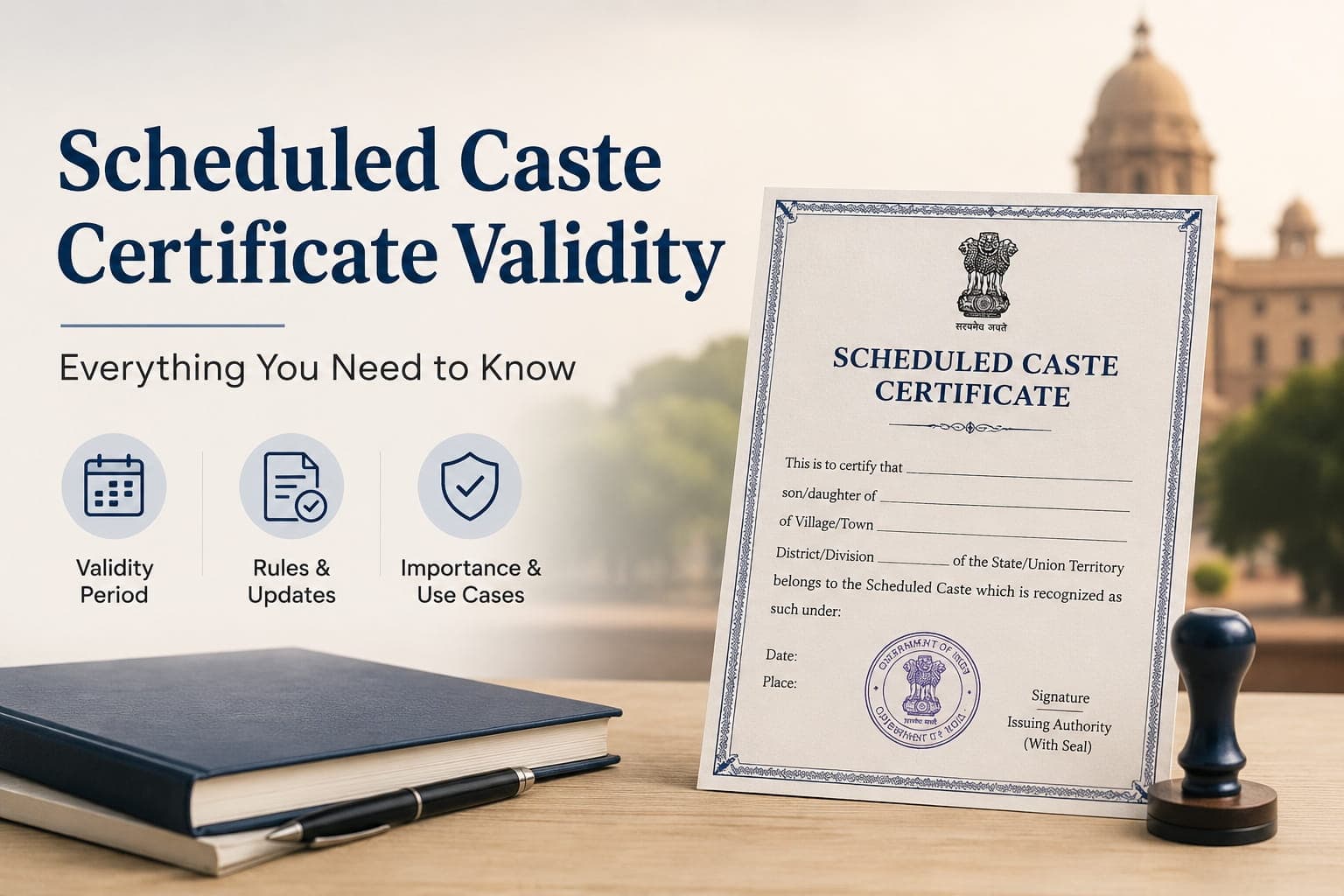
The Scheduled Caste(SC) Certificate is one of the major government documents issued for individuals who belong to the Scheduled Castes recognised by the Constitution of India. The certificate is a valid proof of belonging to a particular caste and gives the right to avail caste reservations, scholarships, welfare programs, education and employment benefits, etc., the government has provided under social justice schemes and policies.
Many people are unsure whether an SC certificate has expired, whether a renewal is needed, and how it is verified for admissions, recruitment, or applications to government schemes. The uncertainties become particularly crucial since the application could be turned down or benefits can be cancelled if the caste information recorded is wrong.
Scheduled Caste certificates are issued by the Government of India and the state government, issued by specific revenue officials like Tehsildars, SDMs, District Magistrates and online service portals. The sc st certificate validity all India is a birth determination, but the effect of the caste certificates can vary in particular cases, according to issuing bodies, when moving between states.
This detailed guide explains the Central vs State caste certificate difference, renewal conditions, verification procedures, eligibility rules, required documents, state-wise considerations, benefits, and important legal guidelines related to caste certification in India.
Overview Of Scheduled Caste Certificate Validity
The table below highlights the key insights of the caste certificate valid in other states of India:-
| Particulars | Details |
|---|---|
| Document Name | Scheduled Caste (SC) Certificate |
| Issuing Authority | Tehsildar, SDM, District Magistrate, Revenue Department |
| Purpose | Proof of Scheduled Caste status |
| Main Benefit | Reservation and welfare scheme eligibility |
| Validity Nature | Generally lifetime validity |
| Renewal Requirement | Usually not required unless specified |
| Applicable Across | India |
| Verification Method | Document and caste verification |
| Mode of Application | Online and Offline |
| Governing Law | Constitution of India & State Rules |
Also Read: Voter ID - Election (EPIC) Card Detail Guide
What Is A Scheduled Caste Certificate?
An official document issued by the government to individuals belonging to communities declared as Scheduled Castes by the Constitution of India, Article 341. The certificate attests that he or she is part of a caste group that is reserved and/or given special treatment by the government.
The government certificate is accepted on admission, government job applications, scholarship applications, competitive examinations and registrations to social welfare schemes. If not, the eligible individuals may not be able to avail the privileges for the SC's.
Normally, the certificate is issued by the authorised revenue officers after checking the caste records, family background, residential details and documents. To ease the application process, many states currently offer online applications on their e-district or citizen service portals.
What Is The Validity Of A Scheduled Caste Certificate?
The Scheduled Caste certificate, which competent authorities issue, remains valid for life in most cases because a person's caste status, which they inherit at birth, remains unchanged throughout their life. The institutions and authorities which require fresh verification need updated certifications and revalidation, according to their practical requirements. The certificate remains valid until its intended purpose needs to check its validity.
Why Is A Scheduled Caste Certificate Important?
The certificate enables people to access multiple constitutional rights and government programs, which support educational progress, economic growth and social inclusion initiatives. The following points talk about the importance of the certificate:
-
Education: Students have a right to reserved seats in schools, colleges and universities, but also in entrance examinations for these places.
-
Scholarship Eligibility: For many of the state & central government scholarships, a valid caste certificate is required.
-
Access to Welfare Schemes: Numerous social welfare initiatives are specifically targeted towards SC communities.
-
Financial Assistance And Subsidies: Various number of loans, grants and entrepreneurship schemes require caste evidence.
Who Can Apply For A Scheduled Caste Certificate?
Only certain individuals are eligible to apply for an SC certificate. The eligibility conditions generally include:
-
The applicant must belong to a caste which the government has officially included in the SC list.
-
Applicants must provide documentation that proves their connection to the specific caste group.
-
Some states require proof of domicile or residence.
-
The authorities conduct record verification as part of the certificate approval process.
Documents Required For Scheduled Caste Certificate
Applicants must submit several supporting documents while applying for the certificate. The table below highlights the commonly required documents:
| Document | Purpose |
|---|---|
| Aadhaar Card | Identity verification |
| Residence Proof | Address confirmation |
| Birth Certificate | Age and identity proof |
| Parent’s Caste Certificate | Verification of caste lineage |
| School Leaving Certificate | Supporting identity record |
| Passport Size Photograph | Application processing |
| Affidavit (If Required) | Self-declaration |
| Income Certificate (Sometimes) | Supporting government records |
How To Apply For A Scheduled Caste Certificate?
The application process of sc st certificate may differ between states, yet it maintains identical procedures throughout India.
Online Application Process
Currently, multiple states offer their residents access to online application services through their official government websites.
Step 1: The applicants should use the authorised e-district website or citizen service website for their application process.
Step 2: Users need to establish their account through mobile number verification and Aadhaar authentication.
Step 3: The applicant must provide exact information about their personal details, caste information, and residential address.
Step 4: The necessary documents must be submitted according to the established document submission standards.
Step 5: The applicants receive an acknowledgement number, which allows them to track their application after their document verification process is complete.
Offline Application Process
The local government offices serve as the physical application sites for applicants who wish to apply.
Step 1: The revenue department offices provide access to application forms.
Step 2: The applicant must present duplicate copies of their identity documents together with their caste-related documents.
Step 3: The officials from the revenue department conduct verification procedures to check family records and their corresponding local information.
Step 4: The SC certificate gets delivered to approved applicants after the verification process reaches its completion.
Also Read: How To Apply For An EWS Certificate? A Step-by-Step Guide
Can A Scheduled Caste Certificate Be Rejected?
The authorities have the power to refuse applications that contain false information or no evidence. The most usual reasons for rejection are:
-
Incorrect Documents: Documents that are mismatched or fake can result in being rejected.
-
No Determination Of Claimed Caste: The claimed caste should have been in the official list of scheduled caste.
-
Failure During Verification: If the submission of these forms is not successful in verifying, the authorities will not accept it.
-
Submitting false information: Individuals whose applications are completed using false information will be subject to legal action.
Difference Between Permanent Validity And Verification Validity
The general public tends to mix up certificate validity with verification validity. The institutions require newly verified documents even though caste status remains permanent. The difference can be understood as follows:
| Aspect | Permanent Validity | Verification Validity |
|---|---|---|
| Meaning | Caste status by birth | Fresh administrative verification |
| Duration | Lifetime | Depends on the institution |
| Renewal Requirement | Generally not needed | May be requested |
| Purpose | Identity confirmation | Admission/recruitment verification |
| Authority Concerned | Revenue Department | Institution or employer |
What Happens During Caste Verification?
Authorities in the reserved categories can make comprehensive verification checks for benefit assessments. The following ways can be used to verify:
-
Family Records: It is also possible to use research methods, which police do, to search for old certificates and family histories.
-
Review of School and Revenue Records: The school records and land records can be requested.
-
Inspection: An on-site, local inspection may occur.
-
Digital systems verify documents against Government databases: Cross Verification with Government-Certified Databases
Can An SC Certificate Be Used In Another State?
The Sakari certificate only serves as an identity document and is accepted nationally, but reservations might be accorded for the caste depending on whether it is a Scheduled caste in the state where the job is to be released. Important points include:
-
Domestic recognition is available: The domestic recognition is a national one.
-
State Specific Reservation Rules Apply: Reservation as recognised in one State may not be recognised in another State.
-
Reservation eligibility at the State level for admissions and empanelments is through local caste lists.
-
Proof of Domicile Change May be Requested: Some States require reapplication for the change in Domicile.
Benefits Of Having A Valid Scheduled Caste Certificate
The Scheduled Caste Certificate offers numerous benefits educationally, socially and economically. Significant advantages are:
-
Reservation of seats: The seats are set aside for SC students at educational institutions.
-
Alternate System of Selection – Reservation policies enhance the jobs with improved representation.
-
Scholarship Opportunities: financial assistance is offered to undertake these studies.
-
Application fees: Only a few institutions have discounted application and tuition fees.
-
Government Welfare Scheme Access: Access to targeted government social schemes for the benefit.
Also Read: Digital Signature Certificate (DSC) In India
Consequences Of Using Fake Scheduled Caste Certificates
The government views issuing fake caste certificates as a serious crime, which is because it interferes with the reservation system. Consequences could be:
-
Withdrawal of Admission or Employment: It is possible to revoke benefits earned from a fake certificate.
-
Legal Action and Criminal Charges: Fraud cases are possible against those who commit a fraud act.
-
Recovering the Assistance of the Government: The Government may recover on having financial assistance made where it is not due.
-
Permanent Disqualification: Future eligibility for government opportunities may be affected.
Challenges Faced During SC Certificate Applications
Although digitisation, there are several practical challenges applicants still face through the digitisation process. The typical issues are:
-
Slow approvals: Administrative backlogs can cause delays in approval.
-
Technical Issues in Online Portals: There might be a problem with the server uploading to a Digital system.
-
Problem in Getting Ancestral Records: It may not always be possible to get older family records.
Conclusion
The Scheduled Caste Certificate acts as a fundamental document which enables qualified citizens to obtain access to educational scholarships, government welfare programs and job opportunities which Indian constitutional law permits. The certificate maintains perpetual validity because people obtain their caste status through birth, which remains constant throughout their lives.
The admission process requires applicants to obtain accurate verification details, while they need to understand state-specific regulations and current documentation standards. The process of accessing government benefits requires organisations to maintain precise records while handling only authentic documents, which helps them avoid legal problems.
The SC certificate functions as a vital tool which helps India achieve its digital governance goals while advancing social inclusion efforts, thus creating equal educational opportunities and economic empowerment paths for historically underrepresented groups throughout the nation.
Why Choose Jaagruk Bharat For The Caste Certificate Application Online?
Jaagruk Bharat makes the caste certificate application process simple, fast, and hassle-free by offering clear guidance at every stage. The platform helps applicants understand eligibility criteria, required documents, application procedures, and verification steps in an easy-to-understand manner.
With step-by-step assistance, users can avoid common mistakes that often lead to delays or rejection of applications. Jaagruk Bharat also provides updated information about state-specific rules, online application methods, and important government guidelines, helping citizens complete the process smoothly and confidently from the comfort of their homes.
Get the latest updates on government schemes and policies with Jaagruk Bharat. Join India's biggest Jaagruk Bharat community. Share your thoughts, questions, and favourite topics with
Frequently Asked Questions
0

0
6k
0
0
6k Views
0

No comments available


