How India‘s Organic Farming Policies Are Changing Agriculture?
Updated: 09-10-2026 at 8:37 AM


3k
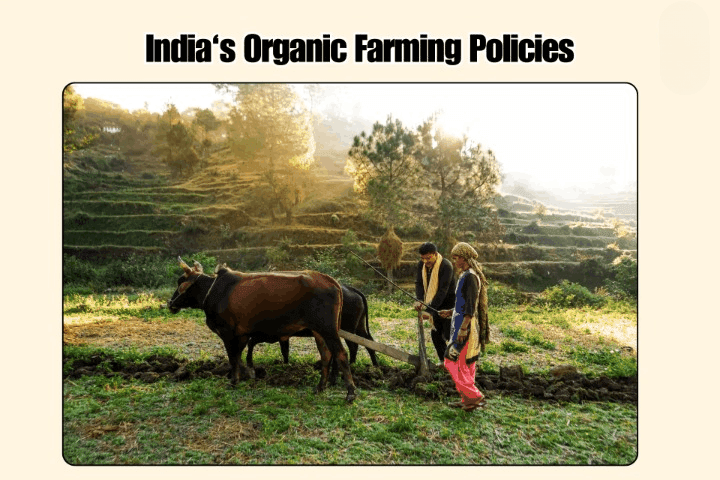
Due to the rapid population growth, the demand for food consumption increased so much that the Green Revolution took place. Crop productivity increased with the use of pesticides and chemical fertilisers. However, these practices polluted the lives of people via the use of soil, air, and water.
As a result of the environment degrading, soil fertility diminished, the government of India launched several organic farming promotion policy in India, such as Paramparagat Krishi Vikas Yojana, Mission Organic Value Chain Development for North Eastern Region, National Mission on Oilseeds and Oil Palm, and many others. The main aim of all the schemes is to ensure that all the farmers in India shift to organic farming methods and techniques with the help of the government.
Read the article to learn more about the organic farming policies by the government, ranging from its meaning and the types of initiatives under it, by the government as mentioned in the Organic Farming Promotion Policy PDF.
Overview
The table below summarises some key details about the government policies for organic farming in India that one should know.
| What Is Organic Farming Promotion Policy? | A basic agricultural system that uses fertilisers of organic origin– green manure, and places emphasis on techniques that protect the environment |
|---|---|
| Paramparagat Krishi Vikas Yojana (PKVY) | It promotes cluster-based organic farming, a change from conventional farming |
| Mission Organic Value Chain Development for North Eastern Region | To promote third-party certified organic farming of niche crops of the northeast region through Farmer-Producer Organisations with a focus on exports. |
| Capital Investment Subsidy Scheme (CISS) under the Soil Health Management Scheme | A scheme that provides 100 per cent assistance for setting up mechanised plants for the production of compost from fruit and vegetable waste and agricultural waste |
| National Mission on Oilseeds and Oil Palm (NMOOP) | The mission provides a 50% subsidy of up to Rs 300 per hectare to boost the fertility of the soil |
Read More: Zero Budget Natural Farming- A Sustainable Approach Towards Organic Growth
What Is Organic Farming Promotion Policy?
Organic farming is a basic agricultural system that uses fertilisers of organic origin– green manure, and places emphasis on techniques such as crop rotation for better soil quality, as well as protecting the environment.
In India, organic farming is very cost-effective, that is to say, one does not need expensive fertilisers and seeds of high yield. With its healthy, good-taste properties, there are large local markets for natural quality produce locally, as well as international markets right across the world. Soil management is the primary mode of organic cultivation used in India.
The Union government offers assistance to Indian farmers to encourage organic farming all over the country under different government schemes. The Minister of State for Agriculture points out that what these schemes emphasise is for Indian organic farmers all end-to-end support: from production, through processing, certification, and marketing, to postharvest management joint support, even though it goes so far as to process things which reduce the cost of organic products.
What Are The Policies Of Promotion Of Organic Farming?
There are several policies introduced by the government of India that promote organic farming. Here is the list of organic farming promotion policies for one’s reference:
Paramparagat Krishi Vikas Yojana (PKVY)
One of the government schemes for organic farming in India is the Paramparagat Krishi Vikas Yojana (PKVY). It promotes cluster-based organic farming, a change from conventional farming. In support of cluster formation, training, certification, and marketing under the PKVY, 100% financial assistance is provided. The assistance of Rs 50,000 per hectare for 3 years is provided directly to farmers through Direct Benefit Transfer(DBT), out of which 62 per cent (Rs 31,000) is given as an incentive to a farmer towards organic inputs. Financial assistance of Rs 20 Lakh per cluster of 1,000 hectares for 3 years is provided for value addition and infrastructure creation.
Mission Organic Value Chain Development for North-Eastern Region
The Mission Organic Value Chain Development for North Eastern Region, or MOVCDNER, is a government scheme for organic farming that aims at promoting third-party certified organic farming of niche crops of the northeast region through Farmer-Producer Organisations with a focus on exports. The assistance of Rs 25,000 per hectare for three years is provided for organic inputs, including organic manure and bio-fertilisers, among other inputs. The scheme also provides support measures for the creation of FPOs, capacity building, and post-harvest infrastructure up to Rs 2 crore.
Capital Investment Subsidy Scheme (CISS) under the Soil Health Management Scheme
Under this scheme, which is one of the organic farming promotion policy in India, the state government and state agencies will get 100 per cent assistance for setting up mechanised plants for the production of compost from fruit and vegetable waste and agricultural waste, up to a maximum amount of 190 lakh per plant
(3000 TPA total capacity per year). Assistance of up to 33 per cent of the cost up to a maximum of 63 lakhs per unit, as capital investment is also provided to individuals and private institutions.
Read More: Soil Health Cards & Policy- RKVY, Fertility, Agriculture & Farmer Scheme
National Mission on Oilseeds and Oil Palm (NMOOP)
Another one of the government initiatives for organic farming is the National Mission on Oilseeds and Oil Palm (NMOOP). For components like biofertilizers, Rhizobium culture, Phosphate Solubilising Bacteria (PSB), Zinc Solubilising Bacteria (ZSB), Azotobacter, Mycorrhiza, and vermicompost, the Mission provides a 50% subsidy of up to Rs300 per hectare. These components can boost the fertility of the soil, increase uptake for whatever crop you are growing, and are friendly to Mother Earth.
Rhizobium culture assists in nitrogen fixation. PSB or ZSB provides plants with a direct source of phosphorus and zinc. Mycorrhiza helps roots increase their surface area, therefore absorbing more nutrients; vermicompost adds organic matter to the soil. Such practices all contribute to higher crop yields as well as a better environment.
Read More: What Are The Top Agriculture Schemes In India In 2025?
National Food Security Mission (NFSM)
In the National Food Security Mission, 50 per cent of the cost, limited to Rs 300 per hectare, is provided as financial assistance for promoting biofertilizers. India has the 9th position, and it has 1.94 million certified agricultural lands in the year 2018-19.
Benefits Of The Organic Farming Schemes
One of the biggest benefits of the organic farming scheme is to reduce dependence on chemical fertilisers and pesticides by increasing the availability and improving the quality of biofertilizers and biopesticides. Some of the other benefits, as laid out in the government schemes for organic farming in India PDF, are as follows:
-
Convert organic waste into plant nutrient resources and prevent pollution.
-
Sustainable, profitable, and respectable agriculture by improving soil fertility to ensure quality products.
-
Ensure soil and water conservation and guarantee nutritional and agricultural biosecurity.
-
Ensure a farmer-controlled domestic market for organic products.
-
Avoid the use of agrochemicals and ensure chemical-free water, soil, air, and food.
-
Ensure seed and food sovereignty and promote biodiversity-based organic agriculture.
-
Ensure quality control of organic inputs and promote human health by providing safe organic products
-
Preserve and expand traditional knowledge of organic farming.
Also Read: How India Is Pushing Forward For a Greener Future With National Mission On Natural Farming!
Conclusion
India tops in terms of the number of farmers engaged in natural farming practices and stands 9th in area under organic farming among 172 countries. The organic farmer has rotating crops, planting throughout the year to maintain biodiversity and the health of the soil. This opens up the potential for year-round employment, revitalised local communities, and reinvigorated global trade that can enhance their income.
Overall, organic farming policies in India are a measure taken by the government to ensure that farmers across the nation shift to organic farming methods and techniques for the green and healthy growth of the agricultural sector, and also align with India’s goal of making the nation sustainable in all aspects.
Stay updated with Jaagruk Bharat to get the latest information on government schemes and more, and reach out to us via our community page if you have any questions or want to share your thoughts.
Why Choose Jaagruk Bharat To Apply For A Farmer Card?
Did you know that Jaagruk Bharat provides various online services to people, like applications, renewals, etc.? Allow Jaagruk Bharat to apply for a Farmer Card on your behalf in just a few clicks! Get 24/7 support, expert assistance, online services, and a hassle-free application Process with Jaagruk Bharat.
Frequently Asked Questions
0

0
3k
0
0
3k Views
0

No comments available


