Agricultural Land And Its Taxability Under Capital Gains
Updated: 10-10-2026 at 8:21 AM


2k
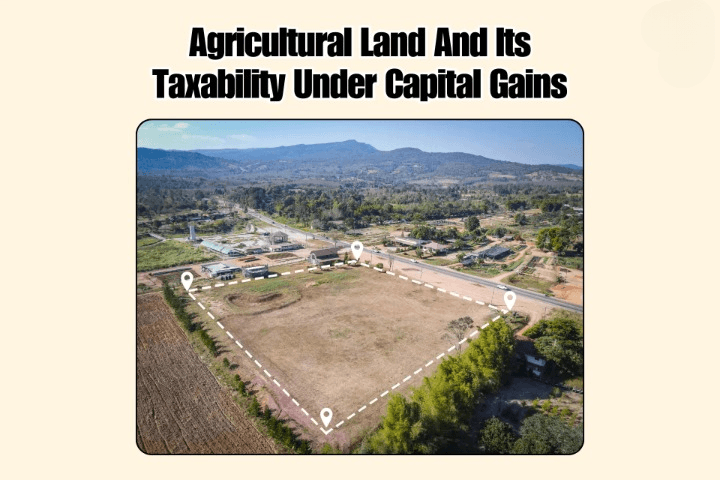
Agriculture remains the backbone of the Indian economy, contributing nearly 14% to India’s Gross Domestic Product (GDP) and supporting the livelihood of more than half the population. Recognising this importance, the government regularly introduces farmer-centric policies, subsidies, and tax relief measures to strengthen the agricultural sector.
One crucial area where tax relief plays a major role is the agricultural land capital gains tax. The Income Tax Act treats agricultural land differently from other assets, offering exemptions and concessional treatment depending on the land’s location and usage. Understanding these rules is essential for landowners, farmers, and investors to ensure compliance while maximising tax savings.
This article explains the tax on the sale of agricultural land, classification rules, applicable tax rates, exemptions, and recent changes in a clear and structured manner.
Also Read: Digital Agriculture Mission: Accelerating Farmer IDs For India’s Agriculture Growth
Overview
Before diving into legal provisions, the table below provides a quick snapshot of how agricultural land is taxed under Indian income tax laws.
| Category | Tax Treatment | Capital Asset Status |
|---|---|---|
| Rural Agricultural Land | Not taxable | Not a capital asset |
| Urban Agricultural Land | Taxable | Capital asset |
| Holding Period > 2 years | Long-term capital gains | Eligible for exemptions |
| Holding Period < 2 years | Short-term capital gains | Taxed at slab rates |
| Sale Value > ₹50 lakh | No TDS applicable | Exempt under the law |
This framework forms the foundation of agricultural land taxability in India and determines whether capital gains arise at all.
How Is Agricultural Land Treated Under Capital Gains?
Under the Income Tax Act, taxation of agricultural land depends entirely on whether the land qualifies as rural or urban. This classification is critical because it determines whether capital gains on agricultural land are taxable or fully exempt.
-
Rural agricultural land is excluded from the definition of a capital asset.
-
Urban agricultural land is treated as a capital asset and attracts capital gains tax on transfer.
In simple terms, rural agricultural land capital gains are not taxable, whereas urban agricultural land capital gains are fully taxable as per applicable rules.
Definition Of Rural Agricultural Land Under Income Tax Act
The Income Tax Act, 1961, clearly defines what qualifies as rural agricultural land. According to the law, agricultural land in India is considered rural if it meets the following conditions.
Location-Based Criteria
The table below explains how distance from a municipality and population size determine taxability.
| Shortest Aerial Distance from Municipality / Cantonment | Population as per the last census |
|---|---|
| Less than 2 kilometres | More than 10,000 |
| More than 2 km but less than 6 km | More than 1,00,000 |
| More than 6 km but less than 8 km | More than 10,00,000 |
If agricultural land does not fall within these limits, it qualifies as rural land and enjoys a capital gains tax exemption agricultural land provision.
Any land failing to meet these conditions automatically becomes urban agricultural land, making it taxable under income tax laws.
Also Road: Krishi Yantra Subsidy Scheme: Agriculture With Innovative Farming Tools
How Is Urban Agricultural Land Taxed In India?
Urban agricultural land refers to agricultural land located:
-
Within municipal limits with a population above the prescribed threshold, or
-
Within specified distance limits from urban local bodies.
Such land is treated as a capital asset, and any profit arising from its transfer is subject to capital gain tax on agricultural land.
This distinction ensures that land near rapidly urbanising areas is not misused for agricultural exemptions for speculative gains.
Tax on Sale of Urban Agricultural Land
Taxation of urban agricultural land depends on the holding period. The holding period determines whether gains are classified as short-term or long-term.
Capital Gains Tax Rates Explained
The table below summarises how gains are taxed.
| Type of Capital Gain | Holding Period | Tax Rate |
|---|---|---|
| Short-Term Capital Gain | Less than 2 years | As per the income tax slab |
| Long-Term Capital Gain | More than 2 years | 20% with indexation |
| Optional Rate (Post Budget 2024) | Long-term | 12.5% without indexation |
This reform gives taxpayers flexibility while computing income tax on agricultural land transactions.
Exemptions Available on Capital Gains from Agricultural Land
The Income Tax Act provides multiple exemptions to reduce the tax on the sale of agricultural land, especially for farmers and HUFs.
Section 54B – Agricultural Land Reinvestment
This section offers relief when capital gains are reinvested into new agricultural land.
-
Applicable to individuals and HUFs.
-
The original land must have been used for agriculture for at least 2 years.
-
New agricultural land must be purchased within 2 years.
This exemption under section 54B agricultural land encourages continuity in agricultural activity rather than speculative selling.
Other Relevant Sections
-
Section 54C – Applies to compulsory acquisition of land.
-
Section 54F – Applies when gains are invested in residential property.
These provisions further strengthen agricultural land sale tax rules for genuine taxpayers.
Is Income from Agricultural Land Always Tax-Free?
While income tax on agricultural land income (such as crop cultivation) is exempt, capital gains taxation depends on land classification.
-
Agricultural income- Fully exempt.
-
Sale of rural land- Exempt.
-
Sale of urban land- Taxable.
This distinction ensures clarity between operational income and asset-based gains.
Also Read: How India's Organic Farming Policies Are Changing Agriculture?
Is TDS deductible On The Sale Of Agricultural Land?
Many taxpayers assume TDS applies to all high-value property transactions. However, agricultural land enjoys special treatment.
Under Section 194-IA:
-
1% TDS applies if the property value exceeds ₹50 lakh.
-
Agricultural land is specifically exempt, even if the sale value exceeds ₹50 lakh.
This exemption significantly reduces compliance burden and protects farmers from cash-flow disruption, reinforcing agricultural land taxability in India.
Common Mistakes Taxpayers Make While Selling Agricultural Land
Despite clear laws, taxpayers often face disputes due to incorrect interpretation. Common mistakes include:
-
Assuming all agricultural land is tax-free.
-
Ignoring distance-based criteria.
-
Failing to claim exemptions under eligible sections.
-
Misclassifying the holding period.
A proper understanding of capital gains on agricultural land avoids penalties and litigation.
Why Understanding Agricultural Land Capital Gains Matters?
Land values near urban areas are rising rapidly. With infrastructure expansion and municipal reclassification, once rural land may now fall under urban limits.
Staying updated on agricultural land capital gains tax rules helps landowners:
-
Plan sales strategically.
-
Optimise exemptions.
-
Avoid unexpected tax liabilities.
This knowledge is especially important for inherited agricultural land and joint family holdings.
Conclusion
The taxation of agricultural land in India strikes a balance between protecting farmers and preventing misuse of exemptions. While rural agricultural land capital gains remain fully exempt, urban agricultural land capital gains attract tax depending on holding period and reinvestment decisions.
By understanding location-based classification, applicable rates, and exemption provisions such as section 54B agricultural land, taxpayers can lawfully minimise their tax burden. Proper awareness of agricultural land sale tax rules not only ensures compliance but also supports better financial planning.
In a country where agriculture forms the economic and social backbone, informed tax decisions empower landowners to protect both their income and their future.
Why choose Jaagruk Bharat To Create Farmers ID?
Jaagruk Bharat makes the Farmer ID creation process simple, reliable, and accessible for farmers across India. With step-by-step guidance, verified information, and user-friendly support, it helps farmers avoid errors and delays. Jaagruk Bharat also ensures farmers understand the benefits linked to Farmer ID, such as access to government schemes, subsidies, and welfare programmes, making the entire process transparent, secure, and hassle-free.
Get the latest updates on government schemes and policies with Jaagruk Bharat. Join India's biggest Jaagruk Bharat community. Share your thoughts, questions, and favourite topics with us.
Frequently Asked Questions
0

0
2k
0
0
2k Views
0

No comments available


