Jaagruk Bharat is a private organization offering support for documentation and government scheme access. We are not affiliated with any government body. Official services are available on respective government portals. Our goal is to make processes easier and more accessible for citizens.
Jaagruk Bharat is a private organization offering support for documentation and government scheme access. We are not affiliated with any government body. Official services are available on respective government portals. Our goal is to make processes easier and more accessible for citizens.
E-Shram Card Vs Labour Card – Key Differences

Updated: 06-05-2026 at 3:30 PM


1k

Serving Over
500K+ Users


A large part of the population of India comes under the unorganised sector, working across various professions and areas, like construction workers, street vendors, domestic workers, agricultural workers, gig workers like food or commodity delivery agents, migrant labourers, manual labourers, etc. However, this large chunk of the population is still deprived of various essential benefits, the same benefits that people covered under the organised sector enjoy, benefits like pension, paid leaves, maternity benefits, and so on.
To bridge this drastic gap between the organised and the unorganised sectors, the government of India introduced the e-Shram card, and state governments introduced labour cards. Both cards are different from each other when it comes to their specifics, but overall, they share the same aim, and that is to help people working in the unorganised sector as and when they need, and help them in improving their quality of life.
Read the article to learn the complete details on an e-Shram card and a labour card, ranging from their meaning and benefits to eligibility criteria and application processes, and ultimate answers to popular questions, like ‘shram card vs labour card kya difference hai?’.
Read More On The Unorganised Workers’ Social Security Act, 2008
E-Shram Vs Labour Card Overview
The table below summarises key details of the key differences between an e-Shram and a labour card that one should know.
| Meaning of an e-Shram card | A government-issued ID card for workers working in the unorganised sector. |
|---|---|
| Meaning of a Labour card | A specific ID card issued by the workers' respective state government authorities. |
| Eshram card and labour card same or different? | Both the cards are different. |
| Issued by | The e-Shram card is issued by the Ministry of Labour and Employment, and labour cards are issued by the state government’s labour departments. |
| Mode of application | Apply for e-Shram via the e-Shram portal and apply for labour cards via the state government’s respective portals. |
What Is An E-Shram Card?
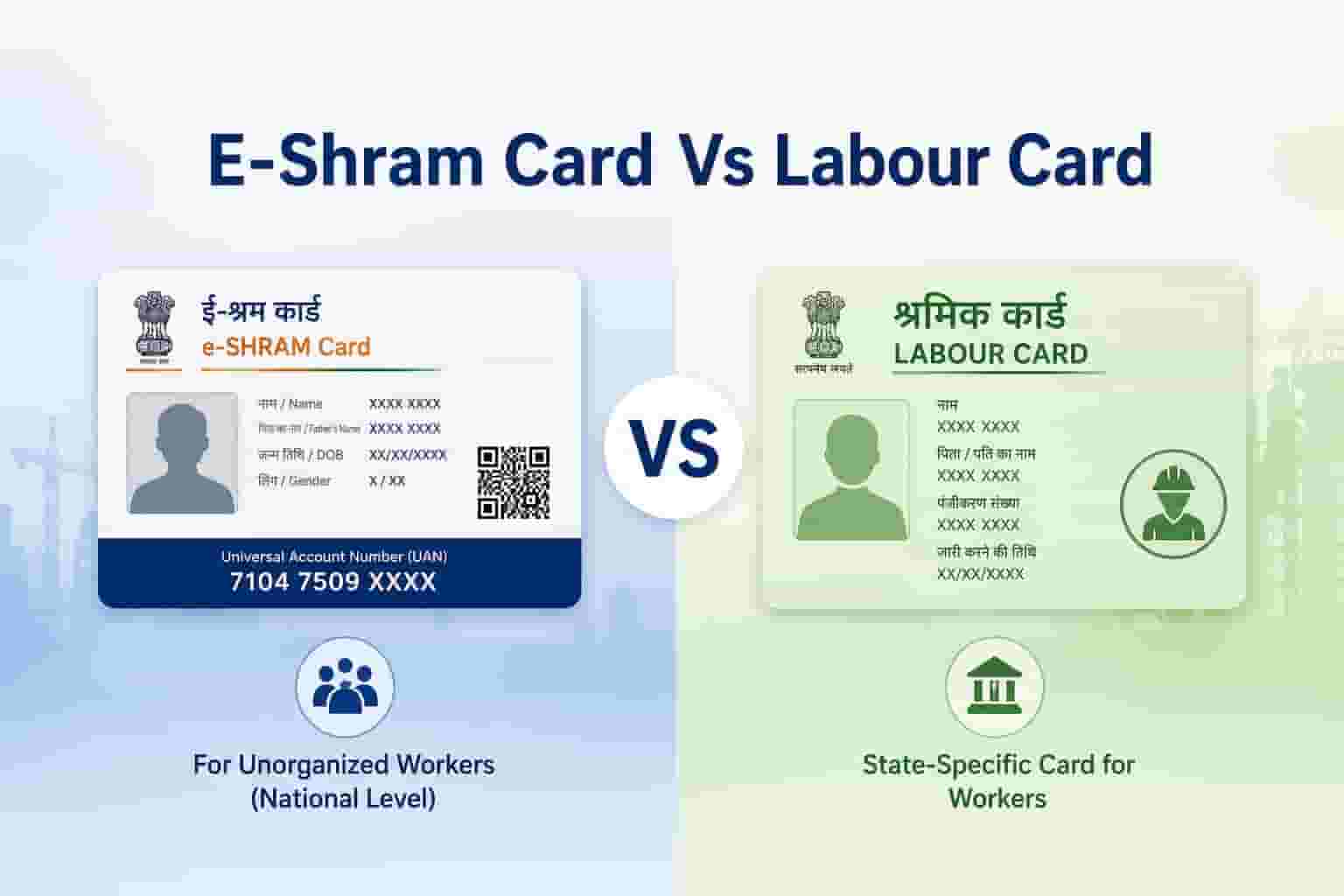
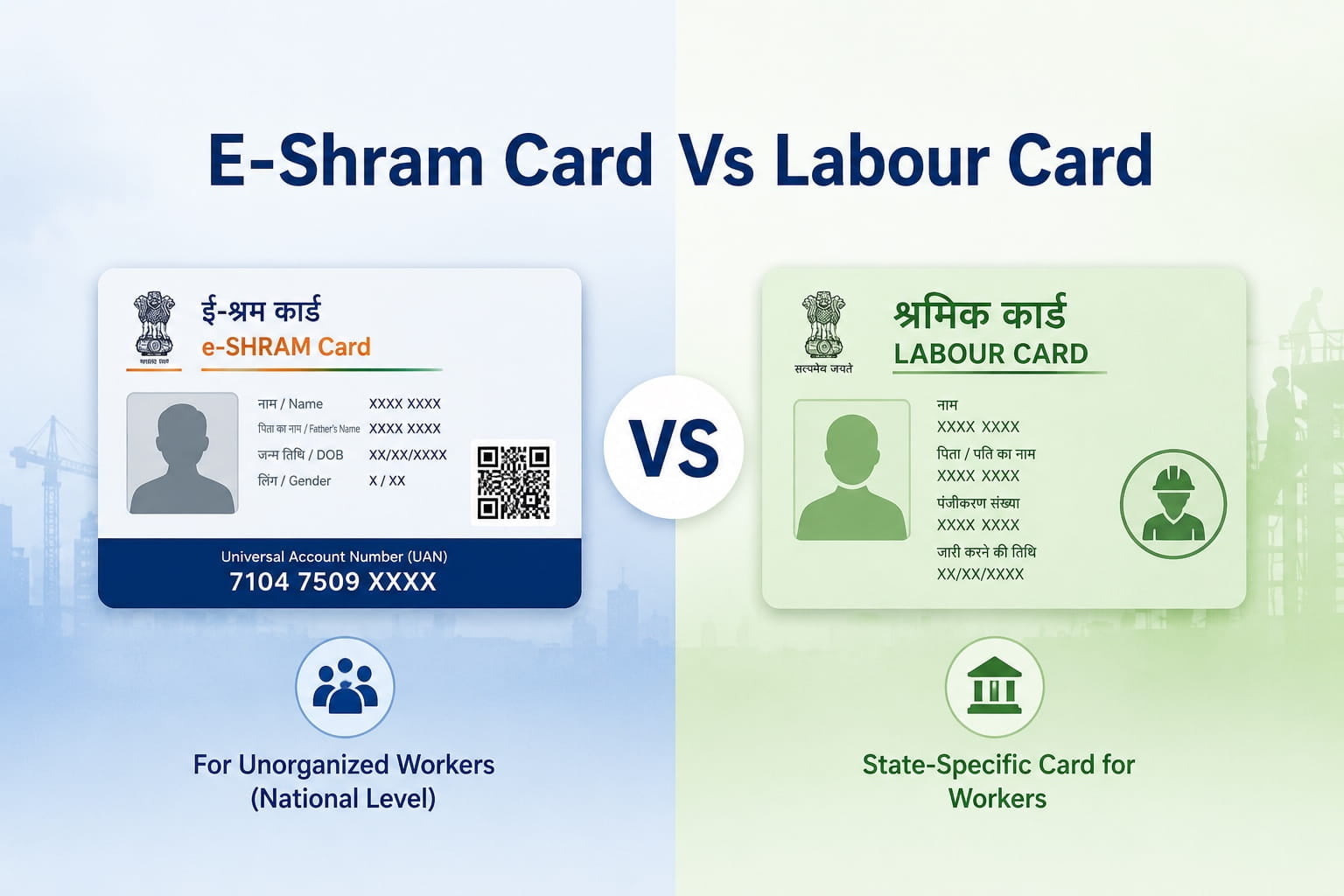
An e-Shram card is a government-issued identification card for workers working in the unorganised sector. The Ministry of Labour and Employment introduced it to provide formal recognition and benefits to professionals in the informal sector, such as construction workers, street vendors, gig workers, and labourers. People with an e-Shram card receive a 12-digit Universal Account Number, which is a unique identity allowing them to access a range of benefits.
What Is A Labour Card?
A labour card is usually issued by the state government’s labour department or the Building and Other Construction Workers Welfare Board (BOCWWB). Unlike the wide focus and portability of the e-Shram card, labour cards are much more about specificity as they are issued to construction workers or manual labourers, like carpenters, welders, electricians, etc., of a particular state. With the help of the labour card, cardholders can access a range of benefits, like eligibility for applying for various state government schemes for various services, such as scholarships for children, medical help, maternity benefits, insurance compensation, etc.
Can I have Both Eshram And Labour card?
Yes, an individual can apply for possessing both an e-Shram card and a labour card if they fulfil the conditions of eligibility. Both cards are issued by different authorities for different purposes, so neither of them acts as a barrier to the other.
Labour Card Vs Eshram Card Benefits Comparison
Both e-Shram cards and labour cards are extremely beneficial in their own ways. We have compiled a detailed and extensive Labour card vs Eshram card benefits comparison points for one’s better understanding.
Benefits Of e-Shram Card
-
One of the most popular benefits that e-Shram cardholders can reap is insurance coverage. Cardholders can apply for various national government-provided insurance schemes, like the Pradhan Mantri Suraksha Bima Yojana (PMSBY), which helps its beneficiaries in receiving financial compensation in case they lose their lives due to an accident or suffer a permanent disability.
-
The e-Shram card is a gateway that opens doors to various other central government-provided social welfare schemes for people working in the unorganised sector. The card connects all the workers to one portal, which makes verifying their eligibility conditions easier and quicker for the authorities and makes the administrative work more efficient.
-
One of the most unique benefits of this card is its nationwide portability. Its main aim is to create a national database of all people engaged in various professions under the unorganised sector, which makes its acceptability not limited to just one area but the entire nation. This is especially useful for migrant workers who often travel from one place to another.
-
A majority of the schemes designed for workers working in the unorganised sector are concerned with financial aid in various forms, like subsidies, low-interest loans, etc. The national database of e-Shram has the banking details of the workers, which makes it easier for the authorities to enable the Direct Benefit Transfer (DBT) mechanism, eliminating the need for any middlemen in between, which automatically reduces the corruption rate.
-
People working in the unorganised sector are often the ones who are the most affected in emergencies, be it natural or man-made. National cards like e-Shram cards help them in dealing with such adverse situations through the government’s support.
Benefits Of The Labour Card
-
Labour cardholders can also apply for various social welfare schemes, but they are usually run by specific state government departments. Schemes concerning various services, like educational assistance, are offered to labourers covered under the unorganised sector, so that their children can pursue education and not stay deprived because of reasons like monetary constraints.
-
There are many state governments’ labour departments that offer pension services to labour cardholders. These are run by authorities so that workers can enjoy retirement-related benefits after they reach a certain age. This pension-related benefit is special because most of the workers covered under the unorganised sector primarily use their physical strength; their jobs are far from an A/C room with a desk and a laptop.
-
Pensions help them in leading comfortable lives when they cannot work because of their age, and also an attempt by the government to bridge the gaps between the organised and unorganised sectors.
-
One of the main advantages that comes with a labour card is access to medical assistance. Labour cardholders can access and avail themselves of the necessary medical help either free of cost or at highly subsidised rates.
-
Labour cards are mainly issued to construction workers or manual labourers. Some of the schemes accessed by this card are concerning housing. Workers possessing labour cards issued by their respective state governments can apply for housing assistance programs and finally see their own house building, and not just others.
Also Read On Mukhyamantri Jan Kalyan Sambal Yojana- Comprehensive Support for Unorganised Workers
Eshram Vs Labour Card Eligibility Difference
Individuals interested in applying for either one of the cards are required to fulfil all the conditions of eligibility to successfully obtain one. The Eshram vs Labour card eligibility difference is as follows:
For E-Shram Card
-
Individuals should be between the ages of 16 and 59 years.
-
An individual must be a part of the unorganised sector.
-
Only people with a valid Aadhaar card linked to their mobile numbers can apply for the e-Shram card.
-
Approved categories of people that can apply for an e-Shram card are construction workers, agricultural labourers, street vendors, domestic workers, migrant workers, auto drivers, small shop employees, etc.
Eligibility For A Labour Card
-
Applicants are usually required to fall within the age range of 18 to 60 years at the time of registration.
-
Most labour boards require proof that the worker has completed at least 90 days of labour work during the previous 12 months.
-
Income limits may apply in certain states to ensure that benefits reach lower-income labour households.
Application Process
When it comes to the application process of e-Shram or a labour card, the ways of applying are surely different, but the cruder overview is the same. One can apply for both cards via both online and offline (Common Service Centres) platforms. Below is a rough outline of the online application process for both cards, so that you can develop an idea of how it happens.
How To Apply For An e-Shram Card?
Step 1: Please visit the official website of the e-Shram portal.
Step 2: On the homepage, you will find the ‘Register on E-Shram’ option under the ‘One Stop Solution’ tab. Click on it. Select the appropriate option when asked about your EPFO and ESCI member status. Validate using the One-Time Password (OTP) that you will receive on your mobile number via SMS.
Step 3: Complete the Aadhaar-based electronic Know Your Customer (e-KYC) verification procedure.
Step 4: Fill in the application form carefully and accurately. The form will ask you to enter your personal information, such as name, date of birth, address, educational qualification, occupation, skills, and banking information.
Step 5: Upload the scanned copies of all the required documents. Ensure they are in the prescribed size and format. Review all the information you filled in the form once before making the final submission, select self-declaration, and then click on ‘Submit’.
How To Apply For A Labour Card?
Step 1: Visit the official website of your respective state government's labour department.
Step 2: Navigate to the name of the scheme for which you are eligible and select it.
Step 3: Fill out the details, such as your personal information, occupation-related information, etc., in the application form carefully and accurately.
Step 4: Upload the scanned copies of all the required documents. Check once before submitting the application form and wait for approval.
Documents Required While Applying For E-Shram & Labour Cards
Applicants need to attach or upload some supporting documents while filling out the applications for either one of the cards. The list of those documents is mentioned below for one’s reference:
| Documents required to obtain an e-Shram card | Needed documents while applying for a Labour card |
|---|---|
| Proof of identity. Proof of labour work, like a contractor certificate. Domicile certificate. Bank account details. | Aadhaar-linked mobile number. Aadhaar card. Proof of residence, and others, as needed. |
Read More On Shramik Parivahan Yojana- Eligibility Criteria And Application Process
Eshram Card Vs Labour Card Difference India
Eshram Card Vs Labour Card difference India is described below in tabular format so that you can compare and see the minor differences both the cards entail.
| Component | e-Shram card | Labour card |
|---|---|---|
| Meaning | The e-Shram card is an identity card for people working in the unorganised sector. | The Labour card is like a registration card so that beneficiaries can apply for the relevant social welfare schemes by the state govt authorities. |
| Introduced by | Ministry of Labour and Employment. | Labour departments under a state govt or as per the frameworks of the Building and Other Construction Workers Welfare Board (BOCWWB). |
| Purpose | To create a single unified national database of all people working in the unorganised sector in India. | Mainly to provide the benefits of social welfare schemes. |
| Covers | Covers a wide range of unorganised workers, like gig workers, street vendors, labourers, etc. | Specifically covers construction workers, like plumbers, electricians, painters, etc. |
| Portability | Can be used across India. | Can only be used within a state. i.e., the state government authority that issued it. |
| Eligibility | People between the ages of 16 to 59 years. | People between the ages of 18 to 60 years. |
| Applied via | One can apply via the e-Shram portal. | Applied via specific state govt portals. |
| Any ID number? | Yes, the e-Shram card has a Unique Identification Number (UAN). | No ID number as such. |
Which Is Better Eshram Card Or Labour Card?
The answer to this question, ‘Which is better Eshram card or Labour card?’ can never be the name of either one of the cards, as it is based upon several facts, essentially the needs of the worker covered under the unorganised sector. The e-Shram card has a nationwide acceptability, making workers eligible for central government schemes and services; on the other hand, a labour card is much more specific, issued to construction workers and manual labourers for accessing state government schemes and services.
Comparing the cards won’t give you the right answer as they are both complementary rather than competitive. If you are eligible for both cards, please apply for both, as they can come in handy anytime.
Read More On Apply For Bina Mulya Samajik Suraksha Yojana- Free Benefits For Unorganised Sector Workers
Conclusion
The e-Shram card and labour card are two of the most important social welfare initiatives run by the central and state government authorities. Their specific differences make them unique and might make it seem like both of them are poles apart; however, in reality, both the cards were made for just one thing, and that is to provide help in various forms to workers working in the unorganised sector, so that they can lead comfortable and fulfilled lives.
Stay updated with Jaagruk Bharat to get the latest information on government schemes and more, and reach out to us via our community page if you have any questions.
Why Choose Jaagruk Bharat To Apply For An E-Shram Card Or A Labour Card?
Allow Jaagruk Bharat to help you and apply for an e-Shram card or a Labour card on your behalf in just a few clicks! Get 24/7 support, expert assistance, online services, and a hassle-free application Process with Jaagruk Bharat.
0

0

1k

0
0
1k Views
0

No comments available


Our Company
Home
About
T&C
Privacy Policy
Eula
Disclaimer Policy
Code of Ethics
Contact Us
Careers
Cancellation & Refund Policy
Categories
Women
Insurance
Finance
Tax
Travel
Transport & Infrastructure
Food
Entertainment
Communication
Government ID Cards
E-commerce
Traffic guidelines
Miscellaneous
Housing and Sanitation
Sports
Startup
Environment and Safety
Education
Agriculture
Social cause
Employment
Disclaimer: Jaagruk Bharat is a private organization offering support for documentation and government scheme access. We are not affiliated with any government body. Official services are available on respective government portals. Our goal is to make processes easier and more accessible for citizens.
All Copyrights are reserved by Jaagruk Bharat