Jaagruk Bharat is a private organization offering support for documentation and government scheme access. We are not affiliated with any government body. Official services are available on respective government portals. Our goal is to make processes easier and more accessible for citizens.
Jaagruk Bharat is a private organization offering support for documentation and government scheme access. We are not affiliated with any government body. Official services are available on respective government portals. Our goal is to make processes easier and more accessible for citizens.
Disha Scheme 2026: Early Intervention Scheme For Children With Disabilities
Updated: 18-05-2026 at 12:30 PM


1k

Serving Over
500K+ Users


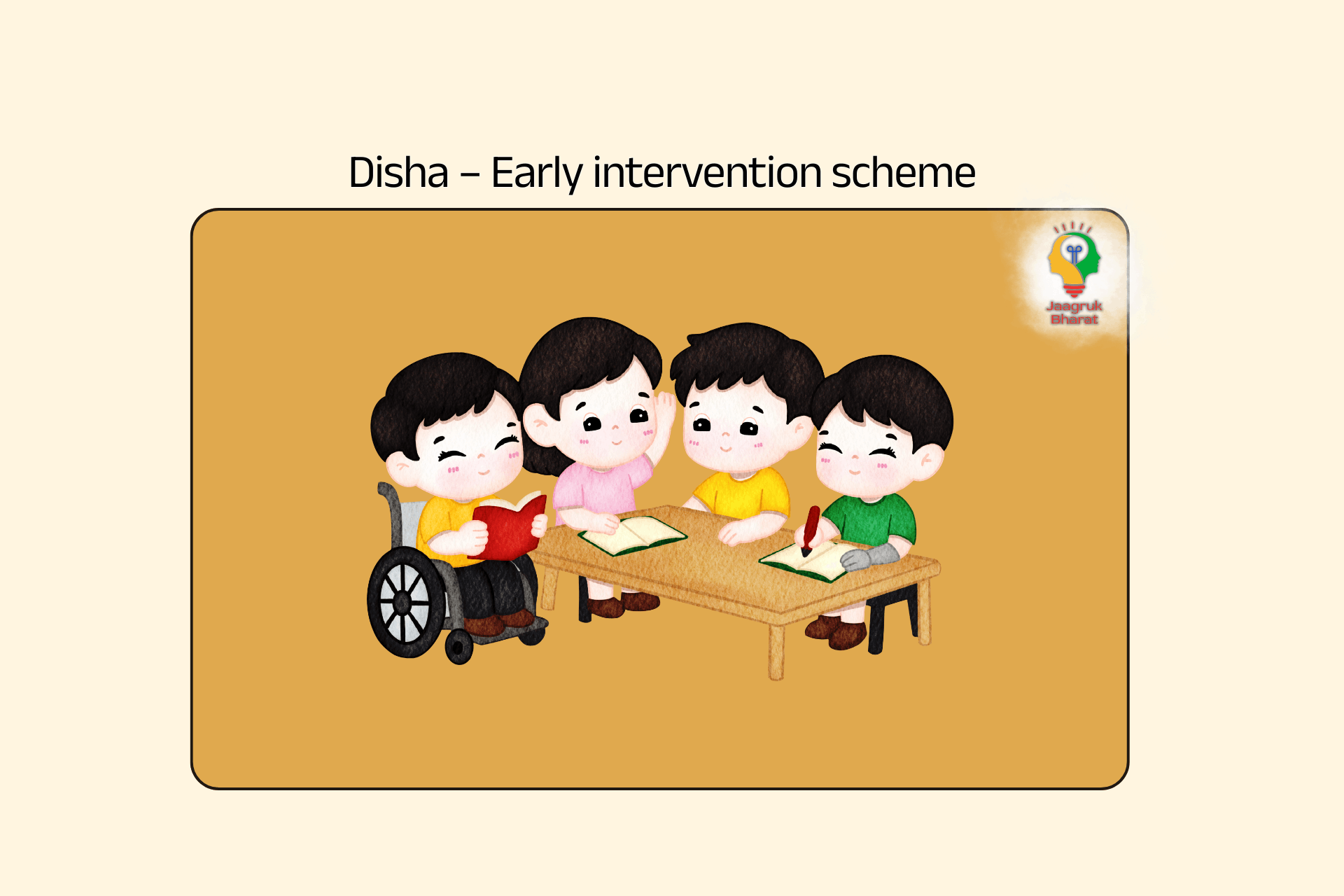
The Government of India rolled out the Disha – Early intervention scheme for children through the Department of Empowerment of Persons with Disabilities under the Ministry of Social Justice and Empowerment. This scheme works under the National Trust Act, 1999, and it is meant to support children with developmental disabilities at a very initial stage.
The main aim of the Disability Early Support Scheme is to help children with disabilities become more self-reliant and also ready for school by using specialised therapies, counselling, coaching, and family support-type services. It also tries to guide parents and guardians so that they understand the developmental requirements of their child more clearly, not just the basics, but the day-to-day needs as well.
In this article, you will get the detailed information about the Disha scheme, its objectives, benefits, enrollment process and much more.
Overview Of The Disha Scheme
The table below showcases the key insights of the Child Development Government Scheme:-
| Particulars | Details |
|---|---|
| Scheme Name | Disha – Early Intervention and School Readiness Scheme or Disha National Trust Scheme |
| Launched By | Department of Empowerment of Persons with Disabilities |
| Ministry | Ministry of Social Justice and Empowerment |
| Implementing Body | National Trust |
| Beneficiaries | Children with disabilities aged 0–10 years |
| Covered Disabilities (Special needs children's education support) | Autism, Cerebral Palsy, Mental Retardation, Multiple Disabilities |
| Main Objective | Early intervention and school readiness support |
| Type of Assistance | Therapy, counselling, training, daycare and family support |
| Application Mode | Offline and through Registered Organisations |
| Official Framework | National Trust Act, 1999 |
Also Read: JBOCWWB - Nishaktata Pension Yojana : Disability Pension Scheme
What Is The Disha Early Intervention And School Readiness Scheme?
The Disha scheme 2026 is an early childhood intervention programme, it is made for kids with developmental and intellectual disabilities. Basically, it tries to help children improve their physical, cognitive, emotional and social abilities, through specialised care plus structured developmental activities.
This scheme also understands that early intervention matters a lot for long-term growth in children with disabilities. When therapies and education support are started during early childhood, children often end up showing better communication, stronger motor skills, improved social behaviour, and even more confidence.
Under the Disha Scheme, approved organisations set up Disha Centres (School Readiness Program India) where children get arranged care, therapy sessions, behavioural support, and developmental training in a secure atmosphere. These centres are meant to strengthen things like communication abilities, motor skills, social engagement, emotional growth, and even the activities of daily living, such as routine tasks.
In practice, the scheme is especially useful for families who need professional direction and rehabilitation support that is more affordable for children with disabilities during their early formative years.
Objectives Of The Disha Scheme
This Preschool readiness scheme has been started with several developmental, as well as social, objectives for children with disabilities, and even for their families. Some of the important ones are described here, in a simpler way.
-
One of the core goals is to give early intervention support to children with disabilities. It is believed that when help is provided during the early years, it can really boost the child’s later growth, and also improve learning abilities.
-
Another objective is making sure children are ready for formal education. This is done through structured training, and school readiness activities, so that the transition becomes smoother.
-
The scheme also tries to support parents and guardians through counselling sessions and developmental guidance. This way, families can understand how to care for and assist children with special needs at home, rather than guessing each step.
-
Improving the quality of life and independence of children with disabilities is also a key part. The scheme does this through therapy support for disabled children, plus developmental programmes that build everyday skills and confidence.
-
Last but not least, creating awareness around disability care, rehabilitation services and inclusive education matters a lot. With this, families can find better opportunities and the support systems that fit their child.
Benefits Under The Disha Scheme
The Disha scheme 2026 offers a range of developmental and supportive services for children with disabilities. It is meant to help the child and their family.
-
Day care facilities: For children enrolled under the Disha scheme, day care is provided for at least four hours a day. During that time, trained staff supervise developmental activities, therapy sessions, learning exercises, plus also a bit of recreational engagement.
-
Therapy and training support: The Government disability welfare scheme makes available specialised therapies in line with the individual needs of the child. In many situations, this can include speech therapy, occupational therapy, physiotherapy, behavioural therapy, sensory development activities and related supports.
-
Counselling for parents and guardians: Parents and guardians also get regular counselling and guidance sessions. These sessions are used to help families understand disability management, behavioural support, emotional care, and everyday living activities, so they can cope better at home.
-
Transport facilities: Some Registered Organisations may provide transport facilities for children who are enrolled at Disha centres, if the arrangement is feasible for both the organisation and the family.
-
Regular assessment and monitoring: Children enrolled under the scheme are assessed regularly by experts and therapists. These assessments help in spotting developmental needs early and tracking progress over time, not just once but consistently.
What Is The Eligibility Criteria For The Disha Scheme?
Children have to meet certain eligibility conditions in order to receive benefits under the Early Intervention Scheme for children. The eligibility conditions are explained below:
-
The child should fall in the age bracket 0 to 10 years at the time of enrolment for the scheme.
-
The child should have one of the disabilities that are covered under the National Trust Act, 1999.
-
The child should also hold a valid disability certificate that is issued by the competent medical authority for checking and verification purposes.
Note that PwDs registered under the SAMARTH Scheme are not eligible for this scheme.
Also Read: Rights of Persons with Disabilities Act - RPwD Act
Disabilities Covered Under The Disha Scheme
The therapy support for disabled children covers disabilities that are recognised under the National Trust Act, 1999.
| Covered Disability | Description |
|---|---|
| Autism | Developmental condition affecting communication and social interaction. |
| Cerebral Palsy | Physical disability affecting movement, posture, and coordination. |
| Mental Retardation | Intellectual disability affects cognitive functioning and adaptive behaviour. |
| Multiple Disabilities | A combination of two or more disabilities causes developmental challenges. |
Who Operates The Disha Centres?
The Disha Centres (support for special needs children education) are run by Registered Organisations ROs, and these are approved by the National Trust. Usually, those ROs are NGOs or other institutions doing disability rehabilitation plus special education work.
Before a RO is allowed to operate a Disha Centre, the National Trust checks and reviews it first. This can involve a physical on-site verification, infrastructure assessments, staff qualifications, and the overall ability to run the centre day to day. Everything gets checked carefully, so the centre can keep working properly, without speculative errors.
What Is The Enrolment Process for Registered Organisations (ROs) Under The Preschool Readiness Scheme or Disha Scheme?
Organisations that are keen to run Disha Centres have to follow the enrolment route outlined by the National Trust. Read the steps below:-
Step 1: First, the NGO or the organisation should register itself with the National Trust via the official National Trust website.
Step 2: The organisation has to fill the registration form on the National Trust portal and also pay the application fees of ₹1,000.
Step 3: After that, the National Trust checks the documents submitted and then schedules a physical, on-site verification of both the organisation and the proposed Disha Centre.
Step 4: If something extra is needed, like more information or documents, the organisation gets a notification. They are usually allotted 15 days to share whatever is missing, without much delay.
Step 5: Once verification is done properly and approval is granted, the National Trust issues a Scheme ID to the organisation.
Step 6: After approval, the organisation receives a Disha starter kit along with operational guidelines from the National Trust.
Step 7: Finally, the National Trust starts the steps for fund release, along with day-to-day operational support for the approved Disha Centre.
What Is The Enrolment Process For Persons with Disabilities (PwDs) At Disha Centres?
Parents or guardians have to follow a proper enrolment process so a child can be admitted under the Disability Early Support Scheme. Read the steps below to understand it better:-.
Step 1: The child should visit the Disha Centre with the required documents and proof of disability.
Step 2: At the Disha Centre, therapists or counsellors conduct an assessment test to understand the child's developmental condition and what kind of support is actually needed.
Step 3: After that, parents receive counselling regarding school readiness, rehabilitation support and developmental planning for the child.
Step 4: If parents decide to enrol the child at the Disha Centre, the organisation checks whether the family falls under LIG or BPL funding support.
Step 5: Then, parents or guardians must submit the enrolment form along with original documents and photocopies of all mandatory papers.
Step 6: Once verification is successful, the child is given enrolment confirmation, along with an ID card or a receipt from the Disha Centre.
Step 7: Lastly, the centre explains the therapy routine, the rules, timings, developmental activities and the support services that are available.
Also Read: State Award For Disabled Persons Scheme.
Documents Required For The Disha Scheme
Applicants should keep all required documents ready before applying under the School Readiness Program India, because it’s better not to rush during submission, or ask for more time at the last moment.
| Document Name | Purpose |
|---|---|
| Enrolment Form | Official application for admission. |
| Birth Certificate or DOB Proof | Age verification of the child. |
| Disability Certificate | Verification of eligible disability. |
| BPL or Income Certificate | Required for LIG/BPL funding support. |
| Parent or Guardian ID Proof | Identity verification of the guardian. |
| Residence Proof | Verification of local address. |
Conclusion
The Disha – Early intervention scheme for children is a key initiative of the Government of India. It assists children who have developmental disabilities during the period when growth matters the most, often the most delicate time. Through therapy support for disabled children, guidance, developmental training, and school readiness assistance, the scheme supports children so they can become more self-reliant and also socially comfortable.
Besides improving the child’s developmental journey, the scheme also strengthens the support system for families through counselling and direction, more steadily and practically. By promoting early intervention and inclusive development, the Disha Scheme 2026 contributes towards building a more supportive and accessible society for children with disabilities in India.
Why Choose Jaagruk Bharat To Apply For The UDID Disability Card Online?
Jaagruk Bharat sort of simplifies the UDID Disability Card online application; it does this with step-by-step guidance and constant assistance during the registration procedure. It also helps users upload documents correctly, skip common application errors and figure out the eligibility conditions without real confusion.
Get the latest updates on government schemes and policies with Jaagruk Bharat. Join India's biggest Jaagruk Bharat community. Share your thoughts, questions, and favourite topics with us.
0

0
1k
0
0
1k Views
0

No comments available


Our Company
Home
About
T&C
Privacy Policy
Eula
Disclaimer Policy
Code of Ethics
Contact Us
Careers
Cancellation & Refund Policy
Categories
Women
Insurance
Finance
Tax
Travel
Transport & Infrastructure
Food
Entertainment
Communication
Government ID Cards
E-commerce
Traffic guidelines
Miscellaneous
Housing and Sanitation
Sports
Startup
Environment and Safety
Education
Agriculture
Social cause
Employment
Disclaimer: Jaagruk Bharat is a private organization offering support for documentation and government scheme access. We are not affiliated with any government body. Official services are available on respective government portals. Our goal is to make processes easier and more accessible for citizens.
All Copyrights are reserved by Jaagruk Bharat