GST Registration Certificate 2026: Download, Verify & What It Contains | Jaagruk Bharat
Updated: 20-05-2026 at 11:50 AM


7k
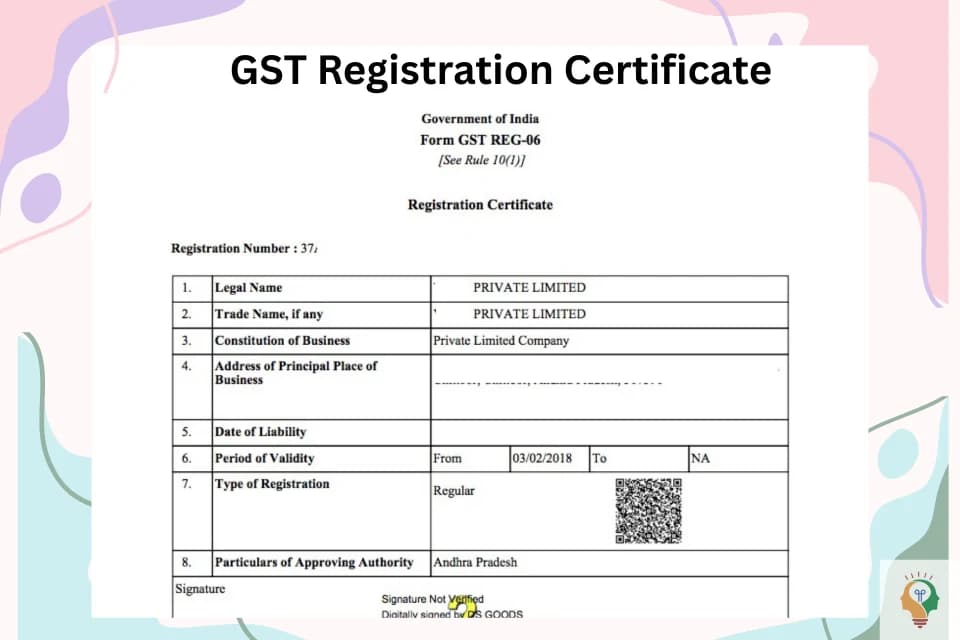
A GST Registration Certificate is an official document issued by the Goods and Services Tax (GST) authorities to businesses that are registered under the GST regime of India. A GST Registration Certificate is mandatory for all businesses to have, through which they can legally conduct taxable transactions. The GST Registration Certificate comprises a unique Goods and Services Tax Identification Number (GSTIN), which is needed for filing GST returns and for claiming credits on tax.
The GST Registration Certificate also enables businesses to charge GST on sales and claim input tax credits on purchases.
There was a time when individuals, families, and businesses faced a burden of taxes that was draining them financially. That’s why the Goods and Services Tax was introduced to organise the complicated tax system of a vast and rich country like India. It has not only streamlined the tax system of the country but also improved transparency and accountability.
One of the measures of GST made for businesses is the GST registration form, through which businesses register for Goods and Services Tax Identification Number (GSTIN). It is a unique number that allows them to complete taxable transactions.
GST Registration Certificate Overview
| Full form | Goods and Services Tax |
|---|---|
| Introduced in | 2017 |
| Benefits | Reduces tax, increases transparency, simplifies the complex process of taxation, etc. |
| GST Structure | It has four slabs: 5%, 12%, 18%, and 28% applied to various goods and services |
| GST Registration Form | GST REG-01 helps businesses to apply for GSTIN |
| Goods and Services Tax Identification Number (GSTIN) | GSTIN is issued to businesses to file returns, collect GST, and conduct legal taxable transactions |
Read More: Difference Between GST Compensation Cess And Income Tax Cess?
What Is A GST Registration Certificate?
A GST Registration Certificate is an official document issued by the Goods and Services Tax Network to those business entities that register themselves under the GST system. The certificate comprises important information, such as the name of the business, GST Identification Number (GSTIN), registered address, date of registration, etc. Eligible parties can apply for the certificate and conduct other functions, like tracking the status of the application and downloading it using an online portal.
Importance Of A GST Registration Certificate
The GST Registration Certificate is important for businesses to legally collect taxes from customers and use the credit that is gained from various purchases made by the business. It also helps businesses in applying for various tax benefits under the GST system and the taxation law of India.
The GST Registration Certificate increases the credibility of a business as well and makes it more appealing to clients and customers. It also enables them to conduct their business operations smoothly while avoiding any legal penalties. All businesses having a turnover of more than Rs. 20 lakhs for services and Rs. 40 lakhs for goods must possess a GST Registration Certificate; otherwise, they would have to face punishable measures like fines.
Key Information On A GST Certificate — What Each Field Means?
The GST Registration Certificate comprises various important components. All of the components are listed below:
-
Goods and Services Tax Identification Number (GSTIN): It is a 15-digit unique identification number that is crucial for filing returns on GST, issuing invoices, and claiming input tax credits.
-
Legal and Trade name: The certificate contains both the legal and trade names of the business.
-
Type of business: It specifies the nature of the business, like proprietorship, partnership, company, or other.
-
Principal place of business: The registered address of the business’s main office is mentioned in the certificate.
-
Date of liability: It is the date from which the business became liable to register under GST.
-
HSN/SAC for goods or services: Harmonised System of Nomenclature (HSN) codes are for goods, and Service Accounting Codes (SAC) are for services listed on the certificate.
-
QR Code: A QR Code is included on the GST Registration Certificate, which provides instant access to the GST details of the businesses.
Read More: Udyam Card: MSME Certificate Download
GST Certificate Vs GSTIN — What is the Difference?
The difference between a GST certificate and GSTIN is mentioned below in a tabular format for one’s reference:
| Component | GST certificate | GSTIN |
|---|---|---|
| Meaning | An official document issued to those businesses that are registered under the GST system. | Goods and Services Tax Identification Number is a unique 15-digit number assigned to every registered taxpayer. |
| Purpose | Serves as proof that a business is registered under the GST system. | The number is used to identify taxpayers for GST filings, invoices, and other tax-related transactions. |
| Issued by | Goods and Services Tax Network | Generated by the Goods and Services Tax system |
| Format | In the form of a digital certificate | 15-digit alphanumeric number |
Gst Registration For Proprietorship / Llp / Pvt Ltd
Various types of business entities can apply for a GST registration certificate. Some of the major types are laid out below.
1. Sole Proprietorship
Sole proprietorship, as the name suggests, is a type of business entity wherein there is only one person managing the whole business. Sole proprietors can also apply for GST registration, which would allow them to legally collect GST and then pay it to the authorities. In this type of business, the GST registration certificate is issued in the name of a sole proprietor, as the identity of the business and the owner is the same.
2. Partnership Firms / LLPs
Partnership firms or even Limited Liability Partnership firms, wherein partners only share a prescribed limit of risk, can also apply and obtain a GST registration certificate. After successful registration, the partnership firm will receive a unique GSTIN, which will be linked to the firm’s PAN card. Using the certificate, partnership firms can collect taxes legally, issue GST invoices, file GST returns, etc.
3. Private Limited / Public Limited Company
Public or Private Limited Companies are also allowed to apply for GST registration and then be legally entitled to collect taxes without any issues. The registration is issued in the name of the company, as it is incorporated under the Companies Act of 2013, and therefore, has its own separate identity.
4. GST Registration For e-Commerce Sellers
Business entities that operate through e-commerce platforms, also known as online marketplaces, must apply for and obtain their GST registration certificates, no matter what their annual turnover amount is.
Who Needs A GST Registration Certificate? Eligibility & Thresholds
Businesses can apply for updating GST Registration details by first ensuring whether they fit into the eligibility criteria or not. The eligibility criteria are as follows:
-
Some of the acceptable reasons that make a business entity eligible to apply for a GST registration are those that go through structural changes, like a change in the type of business entity, businesses that change their principal addresses, or businesses that change their contact methods, like numbers or email addresses.
-
Businesses engaged in supplying their goods and services from one state to another can also apply for GST registration for interstate supply, irrespective of their turnover limits. Please note that even though such small businesses do not have a minimum turnover limit, if the business crosses a certain maximum mark, they will be mandated to apply for GST registration.
-
The composition scheme is designed by the government for small businesses with a turnover of up to Rs 1.75 crore that are in need of a simplified tax system. Such businesses are mandated to apply for composition dealer GST registration and then file their returns quarterly.
State-wise Turnover Thresholds for Mandatory Registration
GST registration becomes mandatory based on a business’s turnover. Distribution of state-wise turnover limits that qualify a business for mandatory GST registration is described below in a tabular format:
| Name of the states | Threshold for goods | Threshold for services |
|---|---|---|
| Maharashtra, Karnataka, Gujarat, Delhi, Tamil Nadu, Uttar Pradesh, Rajasthan, Telangana, Andhra Pradesh, Punjab, Haryana, West Bengal, and most others | Rs 40 lakh | Rs 20 lakh |
| Arunachal Pradesh, Manipur, Meghalaya, Mizoram, Nagaland, Sikkim, Tripura, Uttarakhand | Rs 20 lakh | Rs 10 lakh |
| Jammu & Kashmir, Ladakh, Union Territories | Rs 40 lakh | Rs 20 lakh |
Mandatory Registration Regardless of Turnover (E-commerce, Interstate, RCM)
Some types of business entities are required to register themselves in the GST framework irrespective of their annual turnover rates. Business entities, like those engaged in the interstate supply of goods, those engaged in operating through e-commerce platforms, and those businesses that are required to pay tax following the Reverse Change Mechanism (RCM).
Voluntary GST Registration — When It Makes Sense?
Voluntary GST Registration is nothing but registering one’s business under the GST framework, irrespective of their annual turnover rates. After successful registration, registered businesses are required to comply with all the rules and regulations mentioned in the GST guidelines.
Registering one’s business voluntarily makes sense, specifically for startups, small traders, service providers, and also those business enterprises that wish to claim Input Tax Credit (ITC) on their purchases or other business-related expenses. GST registration also helps businesses in building credibility and gain trust of consumers and other corporate entities.
Documents Required For GST Registration
To complete the GST registration process, businesses need to upload certain supporting documents as well. The list of documents is as follows:
-
Proof of business address
-
Bank account details
-
Photographs
-
Authorisation letters
Also Read: List Of Documents Required For GST Registration In India
GST Certificate Validity — Does It Expire?
A GST registration certificate does not have any fixed expiry date. After successfully obtaining it, it remains valid as long as the business remains operational. However, please note that authorities do have the power to cancel a business’s GST registration certificate if it’s found violating any laws.
How To Apply For GST Registration Online (Step-by-Step)?
Businesses can apply for their GST Certificate Online by following the steps mentioned below:
Step 1: Visit the official portal of GST.
Step 2: Click on ‘Registration’ from the Services tab.
Step 3: Fill out the application form with the business’s details like name, PAN, email address, etc.
Step 4: Upload the necessary documents and click on ‘submit’.
Filling Form Gst Reg-01 On The Portal
All the business entities are required to submit a form called Form GST REG-01through the official portal of GST. Businesses are required to fill in all the requested information in the form, such as the name of the business, registered address, bank details, nature of business, etc., and upload the required documents, and then submit them to the portal. If the form gets approved after thorough verification, the business will receive its GST registration certificate.
Aadhaar Authentication & Biometric Verification (Mandatory from 2025)
Aadhaar authentication for GST / biometric verification GST 2025 is now an important part of completing the GST registration process. This was included by the authorities to strengthen the verification process of people associated with a business applying for GST registration.
Along with Aadhaar verification, businesses are also required to either fill out or update their bank account submission within 30 days GST 2025 to avoid any compliance-related issues.
ARN Generation & How to Track Your Application Status?
The process of generating an Application Reference Number (ARN) and tracking its status is fairly simple. The GST registration status / ARN status check steps are as follows:
Step 1: After completing the application process, ensure to note the Application Reference Number.
Step 2: Visit the official portal of GST.
Step 3: Click on the ‘Services’ option and then navigate to the ‘Registration’ option, wherein you will find the ‘Track Application Status’ option.
Step 4: Enter your ARN, validate using the captcha code, and then the portal will display the status of your application for GST registration.
How Long Does GST Registration Take/ARN Tracking?
Usually, GST registration takes about a week, excluding the weekend, after successfully applying for it. The authorities conduct a thorough verification process, only after which the certificate is issued to the accepted businesses. The process may stretch beyond a week if the authorities require more information from the businesses that applied for the registration.
GST Certificate Issued In Form REG-06 — What Happens Next?
As soon as the application gets approved, the GST department issues a GST registration certificate in form REG-06. This form or certificate comprises all the significant information related to the registered business entity.
After receiving the Form GST REG-06, businesses can start collecting the Goods and Services Tax from people, issue GST invoices, and apply to claim Input Tax Credit on eligible purchases.
How To Download Your GST Registration Certificate?
The process of GST certificate download online / download GST certificate from portal is as follows:
Step 1: Visit the official portal of GST.
Step 2: Log in using your credentials.
Step 3: Navigate to the ‘Download Certificate’ option from the ‘Services’ tab.
Step 4: Download the GST Registration Certificate.
How To Update GST Registration Details?
One can update details in their GST registration certificates by following the steps described below for one’s reference:
Step 1: Visit the official portal of GST.
Step 2: Log in using your credentials.
Step 3: Navigate the ‘Amendment of Registration Core or Non-core Fields’ option from the ‘Services’ tab.
Step 4: Fill in the details of the necessary updates.
Step 5: Submit the supporting documents with the form and wait for approval.
What To Do After GST Registration?
After successful submission and verification, the GST Registration Certificate is issued to the business that they are required to display at their principal place of business. After receiving the certificate, businesses can start collecting taxes on all taxable goods and services and issuing GST-compliant invoices.
Core Fields (Require GST Officer Approval)
Core fields are those fields that require significant details that need approval from the GST Authorities in case of any proposed changes, such as legal business name, principal or additional place of business, or addition or deletion of partners or directors.
Changes to such significant information of a business entity are made by submitting an amendment application, which is reviewed by a GST officer, and if approved, the changes will be made.
Non-Core Fields (Self-Service Amendments)
Non-core fields are those fields that consist of minor details that can be updated without any approval, such as a change in contact information, business bank account details, or a business’s trade name.
Can You Change PAN Or State On A GST Certificate?
The PAN Number or the state cannot be changed once a business successfully receives its GST Registration Certificate. Still, if changes are to be made, businesses need to apply for a new GST Registration Certificate.
How To Display A GST Certificate — Legal Obligations
As per the GST rules, every registered entity is required to properly display its respective GST certificates at the place of its business. Certain points to keep in mind regarding its display are as follows:
-
The GST certificate must be displayed at the principal place from where the business operates, and ideally, it should be attached to a place from where every person can see it as soon as they enter the premises of the business.
-
If a business operates from more than one location, a copy of the GST certificate should be displayed at each place (all places mentioned in the certificate).
-
Every business entity is required to inscribe its business’s GST Identification Number on the name board or signboard at the entrance of the business so that people can easily identify and differentiate between GST-registered and non-registered businesses.
-
If the information in the certificate has been changed or updated, all businesses must change the affixed certificates at all their locations.
-
Registered businesses are also required to mention their GSTIN numbers on their issued invoices, bills, and other business-related documents.
Penalties For Not Registering Under GST
GST registration becomes mandatory when a business crosses a certain prescribed threshold limit. However, if a business that has crossed the prescribed turnover threshold continues to operate without registering itself in the GST framework, it will be liable to pay the penalties. The principal authority in charge of this is the DGGI / CBIC GST registration enforcement.
The GST registration penalty / penalty for not registering, specifically the exact amounts, is as follows:
| Instance | Penalty |
|---|---|
| Fail to register when needed | Rs 10,000 or 10% of tax due, whichever is higher |
| Intentional tax evasion due to not registering in the GST framework | Rs 10,000 or the complete tax due, whichever is higher |
| Collecting tax without proper registration | Tax amount, along with penalties and legal action if needed |
| Failure to abide by the GST rules and regulations | Penalty that can go up to Rs 25,000 |
How To Verify GST Certificate / Fake GST Certificate Check?
It is very straightforward to verify a GST registration certificate and find out which ones are fake and which ones are authentic. The verification of a business’s GST certificate can be done online by following a simple process, which is broken down into steps below:
Step 1: Please visit the official portal of GST.
Step 2: Click on ‘Search Taxpayer’ and navigate to the option of ‘Search by GSTIN or UIN’.
Step 3: Enter the 15-digit alphanumeric GST Identification Number, which is mentioned in the GST certificate of a business entity.
Step 4: Validate using the captcha code, and then if the portal displays significant information about the business in question and if it matches with the information in the certificate, one can conclude that the business’s GST certificate is legit and not fake.
Also Read: GST 2.0 In India: Reforms, New Tax Structure & Impact On Consumers And Businesses In 2026
Conclusion
The GST Registration process is a simple procedure for businesses operating in India. The certificate allows business entities to comply with the Indian taxation system. It is also crucial and mandatory for all businesses above a certain turnover to possess a GST Registration Certificate to reap all the benefits associated with it.
Overall, the GST registration is created by the authorities to make the system much more transparent and to ensure that all businesses operating in India comply with the tax laws efficiently.
Stay updated with Jaagruk Bharat to get the latest information on government healthcare schemes and more, and reach out to us via our community page if you have any questions.
Frequently Asked Questions
0

0
7k
0
0
7k Views
0

No comments available


