Jaagruk Bharat is a private organization offering support for documentation and government scheme access. We are not affiliated with any government body. Official services are available on respective government portals. Our goal is to make processes easier and more accessible for citizens.
Jaagruk Bharat is a private organization offering support for documentation and government scheme access. We are not affiliated with any government body. Official services are available on respective government portals. Our goal is to make processes easier and more accessible for citizens.
Jaagruk Bharat is a private organization offering support for documentation and government scheme access. We are not affiliated with any government body. Official services are available on respective government portals. Our goal is to make processes easier and more accessible for citizens.
Jaagruk Bharat is a private organization offering support for documentation and government scheme access. We are not affiliated with any government body. Official services are available on respective government portals. Our goal is to make processes easier and more accessible for citizens.
Choosing the Wrong GST Type Can Cost You – Learn All Types Now

Updated: 23-03-2026 at 3:30 PM


1k

Serving Over
500K+ Users


Since the introduction of the Goods and Services Tax (GST) framework, the taxation system of India has become much more organised, streamlined, and non-burdensome for the taxpayers of India, both individual and industrial. One of the important processes under this system is the process of GST registration in India, which brings a range of benefits for registered business entities. The process of registration is not just one, but is further divided into various sub-categories to cater to the specific needs of a business model. Therefore, a business should select the most beneficial type of GST registration.
Read the article to learn more about the specifics of the GST registration in India, ranging from its meaning and types to the ideal type of registration based on a business model, including brief information on the GST registration online process.
GST Registration Types Overview
The table below summarises key details of GST registration in India that one should know about.
| What is GST registration? | An official process through which a business or an individual enrols itself under the GST framework. |
|---|---|
| Objective | To collect taxes, issue invoices, and claim input tax credit. |
| How many types of registration are there? | Roughly ten |
| Major GST registration categories | Regular, Composition scheme, Casual and Non-Resident Taxable Person, Input Service Distributor, SEZ, TDS, TCS, and Voluntary. |
| Mode of registration | Online through the GST portal |
Read More: GST Frauds in India- Types, Penalties, Cases & How to Report
What Is GST Registration?
Goods and Services Tax (GST) registration is an official process through which a business or an individual enrols itself under the GST framework. After successfully registering one’s business in the GST framework, the entity receives a GST registration certificate, which comprises a unique Goods and Services Tax Identification Number (GSTIN). There are several benefits of getting oneself registered under the GST framework, such as legal allowance to collect taxes from clients or consumers, to issue tax invoices, file returns, and claim Input Tax Credit (ITC).
The process of registration can be done with the help of the official GST portal only after fulfilling all the conditions of eligibility. However, everyone needs to know that GST registration is not a type of registration; it is an umbrella under which various types of registration lie, like regular registration, input service distributor registration, and others.
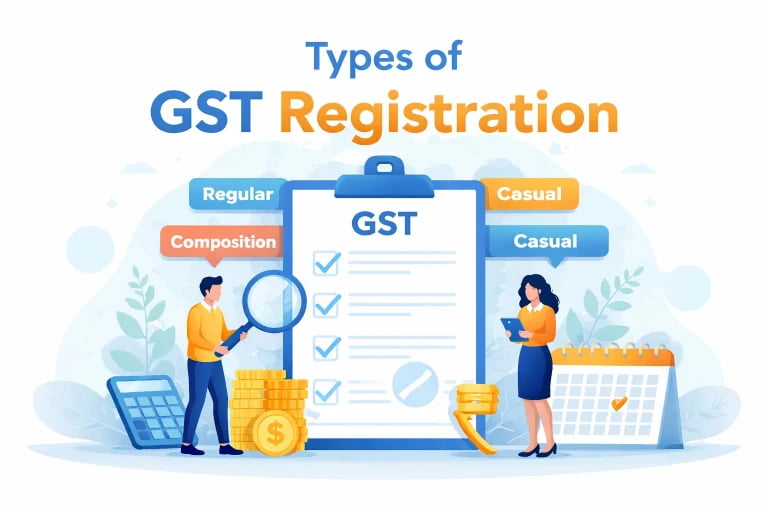
What Are The Types Of GST Registration In India?
There are different types of GST Registration in India, mainly ten, and all of them are described below in detail for one’s better understanding. We have to explain types of GST registration with examples to make it even more simplified for you.
1. Regular GST Registration
Regular GST registration meaning is that, as the name suggests, it is the most widely applied category under the GST registration framework. Any business entity or model that crosses the annual turnover limit or comes under the mandatory registration criteria is required to select this type of GST registration. This type of registration never expires; however, businesses registered under this type are required to file monthly, quarterly, or annual returns based on their turnover amount. After completing the registration process, businesses with a GST registration certificate can collect taxes from people, apply for claiming input tax credit, issue invoices, etc.
The annual turnover limit is different for each type of business entity based on the nature of the work they do, such as:
-
Rs 40 lakhs for goods providers
-
Rs 20 lakhs for service providers in special category states
-
Rs 10 lakhs for businesses in special category states, like the North-Eastern states
For example, a cloth manufacturer in Dehradun has an annual turnover of Rs 60 lakhs. He supplies his clothes to retailers in Maharashtra and Jharkhand. As his business crosses the prescribed threshold limit and engages in interstate supply, he must register his business under the GST framework.
2. Composition Scheme GST Registration
The Composition Scheme is a simplified GST option created especially for small businesses, so consider it an ideal GST registration types for small business. Businesses that want to avoid complex compliance with tax laws can opt for this type of registration to make their lives easier. Following the provisions of this composition scheme, small business entities can pay tax at a lower rate; however, they cannot claim input tax credit on their purchases.
Businesses with an annual turnover of around Rs 1.5 crore or Rs 75 lakhs for some special category states can apply to reap the benefits of this tax-related scheme. They are also required to file for quarterly returns. Please note that this scheme has some limitations, along with not being able to claim ITC, businesses covered under this scheme also cannot issue tax invoices but a bill of supply, and they cannot engage in inter-state supply of goods or with the help of e-commerce platforms.
Tax rates applied to businesses under this scheme are as follows:
-
1% for traders (of both goods and services)
-
5% for manufacturers
-
6% for service providers (under the new scheme introduced in the year 2019)
For example, a small grocer with an annual turnover of Rs 40 lakhs applies for the composition scheme. So instead of calculating GST on every sold vegetable, he will just have to pay a fixed percentage of his business’s total turnover as tax.
3. Input Service Distributor GST
Input Service Distributor (ISD) GST registration is used by those companies that receive input services from one central place but distribute them across multiple branches separately registered under the same Permanent Account Number (PAN). Here, the Input Service Distributor must be a registered office or the headquarters of a business entity, and the distribution is based on the business’s proportionate turnover.
For example, a company whose head office is in Pune and has branches established in Bangalore, Hyderabad, and Ahmedabad. The Mumbai office pays for GST on a nationwide advertising campaign, and with the help of an Input Service Distributor registration, the head office will distribute the input tax claim to all branches in proportionate amounts.
4. Casual Taxable Person GST
Casual Taxable Person GST registration is meant for those types of businesses that do not have a fixed place of business where they can operate, but wish to sell their goods and services in a taxable area occasionally. This type of GST registration is usually for a short period of time, generally roughly valid for around 90 days, which can be extended for another 90 days.
Casual Taxable Persons are also required to make an advance deposit of the estimated tax liability for the period of GST registration. They can apply for claiming input tax credit, subject to proper filing of returns based on the actual supplies made by the business during the registration period.
For example, a handicraft seller from Bikaner is participating in a 2-week exhibition organised in Mumbai. Since they will be selling their goods in the state of Maharashtra without a fixed business address, they will be required to register as a Casual Taxable Person and pay the estimated Goods and Services Tax in advance.
5. Non-Resident GST Registration
As the name suggests, Non-Resident Taxable Person GST registration is like Casual Taxable Person but specifically created for individuals or businesses located outside of India who occasionally supply their goods and services in India. Just like a Casual Taxable Person, this type of registration is also temporary in nature (valid for around 90 days) and requires an advance payment of estimated GST. A Non-Resident Taxable Person can also apply for claiming input tax credit on the goods and services sold in India.
For example, a UK-based company providing software consulting services to Indian clients for a period of 3 months. As they are foreigners, they will have to register themselves as a Non-Resident Taxable Person and deposit estimated GST in advance.
Also read: CBIC Drops GSTR-9 Annual Return Filing For Certain Businesses In FY 2023-24!
6. GST Registration For e-Commerce Sellers
E-commerce operators are mandated to register themselves under the GST framework, irrespective of their annual turnovers. They are responsible for collecting Tax Collected at Source on behalf of sellers and then are required to deposit it all to the relevant authorities. E-commerce sellers must deduct TCS at 1% on the net value of taxable supplies made through the online platform and are also required to file for monthly and annual returns without fail.
For example, when a seller makes a sale through an online platform, the platform will collect a small percentage in the name of Tax Collected at Source and will then deposit the collected amount with the government authorities.
7. Special Economic Zone (SEZ) Developer Or Unit
This type of GST registration is applicable to those businesses that are located in a Special Economic Zone. Such zones are considered foreign territories for trade-related activities, so supplies to and from SEZs are considered imports and exports. Businesses established within a Special Economic Zone can reap various benefits, such as zero-rated supplies without paying tax (based on some conditions). Such businesses are also required to maintain separate records for SEZ and non-SEZ operations and file regular GST returns.
For example, a company established within a Special Economic Zone provides its services to foreigners. Such a company will not charge GST on exports and will be able to claim refunds on paid GST for work-related expenses.
8. Tax Deducted At Source (TDS)
Tax Deducted at Source (TDS) Registration is specifically for special entities, like government departments and agencies. Such entities are required to deduct TDS under the GST framework when paying suppliers. Tax Deducted at Source is deducted at a rate of 2% (1% Central GST and 1% State GST) on payments exceeding the limit of Rs 2.5 lakhs to a supplier. Here, the authorised entities are required to file monthly returns without any delays, and suppliers here can claim the deducted TDS as input tax credit while filing their GST returns.
For example, a government department gets into a contract with a private entity and is supposed to give them Rs 10 lakhs. During payment, the department will deduct a certain percentage as TDS under the GST framework, which will be later deposited with the relevant government authorities.
9. Tax Collected At Source (TCS)
Tax Collected at Source is related to e-commerce operators who are responsible for collecting tax at the source when someone makes a sale through their online platform. E-commerce operators are required to collect Tax Collected at Source at 1% on the net value of taxable supplies sold by others using their platform. Along with this, TCS collectors are required to file monthly returns without fail and issue a TCS certificate to suppliers proving that the TCS was collected. Here also, suppliers can claim the deducted TCS as input tax credit while filing their GST returns.
For example, a seller lists her product on an online e-commerce site. When a sale happens, the online platform will collect a small percentage as Tax Collected at Source and will then deposit it into the concerned government department.
10. Voluntary GST Registration
Voluntary GST registration, as the name suggests, is for those business entities with an annual turnover that does not cross the mandatory threshold, but they still willingly choose to register their business under the GST framework. After registration, businesses can enjoy a range of benefits such as the ability to claim input tax credit. Voluntarily registered businesses are required to file regular GST returns and comply with all that the framework demands.
Difference Between Regular And Composition GST
The difference between regular GST and Composition Scheme GST is mentioned below in brief in a tabular format for one’s ease and convenience:
| Component | Regular GST Registration | Composition Scheme GST Registration |
|---|---|---|
| Meaning | Standard registration where tax is paid at the applicable rates. | A scheme wherein tax is paid at a fixed percentage of annual turnover. |
| Eligibility | Businesses exceeding a certain threshold limit or are just mandatorily required to do so based on other conditions. | Small taxpayers with an annual turnover of up to Rs 1.5 crore or lower in some states. |
| Nature of registration | Mandatory or voluntary, based on additional conditions. | Optional |
| Collection of GST | Can collect GST from customers | Cannot collect GST separately from customers. |
| Tax slab | Applied GST rates (5%, 12%, 18% based on the goods or services provided). | Fixed rate (like 1% for traders, 5% for restaurants, or 6% for service providers). |
| Input Tax Credit | Can claim Input Tax Credit on purchases. | Cannot claim Input Tax Credit. |
| Interstate supply | Allowed | Not allowed |
| Suitable for | Medium to large business models, B2B, and others wishing to expand. | For small and local business entities. |
Read More: GST Rate Slab 2026: Complete List (0%, 5%, 18%, 40%) | Updated
Which GST Registration Is Best For Startup?
As startups come under the category of small businesses, the ideal type of GST registration that they should apply for is regular GST registration. It is not that complicated in comparison to other types of registration and comes along with a range of benefits that startups can reap.
How To Register For GST?
Eligible businesses can apply for GST registration through an online platform. The GST registration process is broken down in steps below for one’s clarity:
Step 1: Please visit the official website of the GST portal. Click on ‘Services’, then ‘Registration’, and then ‘New Registration’.
Step 2: Navigate to the correct application form and fill in the details carefully and accurately.
Step 3: Upload the scanned copies of all the required documents.
Step 4: Recheck the filled details and the order of the documents attached, and then click on ‘Submit’.
To refer to the exact application process, please read our detailed and extensive article on the GST Registration process.
What Is The GST Registration Eligibility Criteria?
A business entity is required to fulfil the eligibility criteria to apply for GST registration; the criteria are based on the type of business model and the turnover limit. Some essential information concerning the eligibility criteria is mentioned below in a tabular format:
| Type of entity | Threshold |
|---|---|
| Goods supplier | Annual turnover should be above Rs 40 lakh (Rs 20 lakh in some special states). |
| Service providers | Annual turnover should be above Rs 20 lakh (Rs 10 lakh in some special states). |
| Interstate sellers | Mandatory irrespective of the turnover of the seller. |
| E-commerce sellers | Mandatory |
| Distributors | Mandatory |
| Special Economic Zone units or developers | Mandatory |
| Non-resident suppliers | Mandatory |
| Voluntary registration | Optional |
List Of Required GST Registration Documents
Businesses are required to attach some supporting documents while applying for the GST registration process. The list of supporting documents is as follows:
-
Business-related documents, based on the types of documents, such as partnership-related documents, Memorandum and Articles of Association, if it’s a company
-
Others, as required
Also Read: GST 2.0 In India- Reforms, New Tax Structure & Impact
Conclusion
The GST registration process is a crucial process that determines a business’s relationship with the Indian tax system. The authorities have created several types of registration, giving businesses a wide variety of options to select from based on their needs and eligibility. Businesses must select the right type of GST registration, as it is not just a formality; therefore, please understand each type of registration carefully before making a final decision.
Stay updated with Jaagruk Bharat to get the latest information on government schemes and more, and reach out to us via our community page if you have any questions.
Why Choose Jaagruk Bharat To Complete Your GST Registration?
Allow Jaagruk Bharat to help you and apply for GST registration on your behalf in just a few clicks! Get 24/7 support, expert assistance, online services, and a hassle-free application Process with Jaagruk Bharat.
0

0

1k

0
0
1k Views
0

No comments available


Our Company
Home
About
T&C
Privacy Policy
Eula
Disclaimer Policy
Code of Ethics
Contact Us
Careers
Cancellation & Refund Policy
Categories
Women
Insurance
Finance
Tax
Travel
Transport & Infrastructure
Food
Entertainment
Communication
Government ID Cards
E-commerce
Traffic guidelines
Miscellaneous
Housing and Sanitation
Sports
Startup
Environment and Safety
Education
Agriculture
Social cause
Employment
Disclaimer: Jaagruk Bharat is a private organization offering support for documentation and government scheme access. We are not affiliated with any government body. Official services are available on respective government portals. Our goal is to make processes easier and more accessible for citizens.
All Copyrights are reserved by Jaagruk Bharat